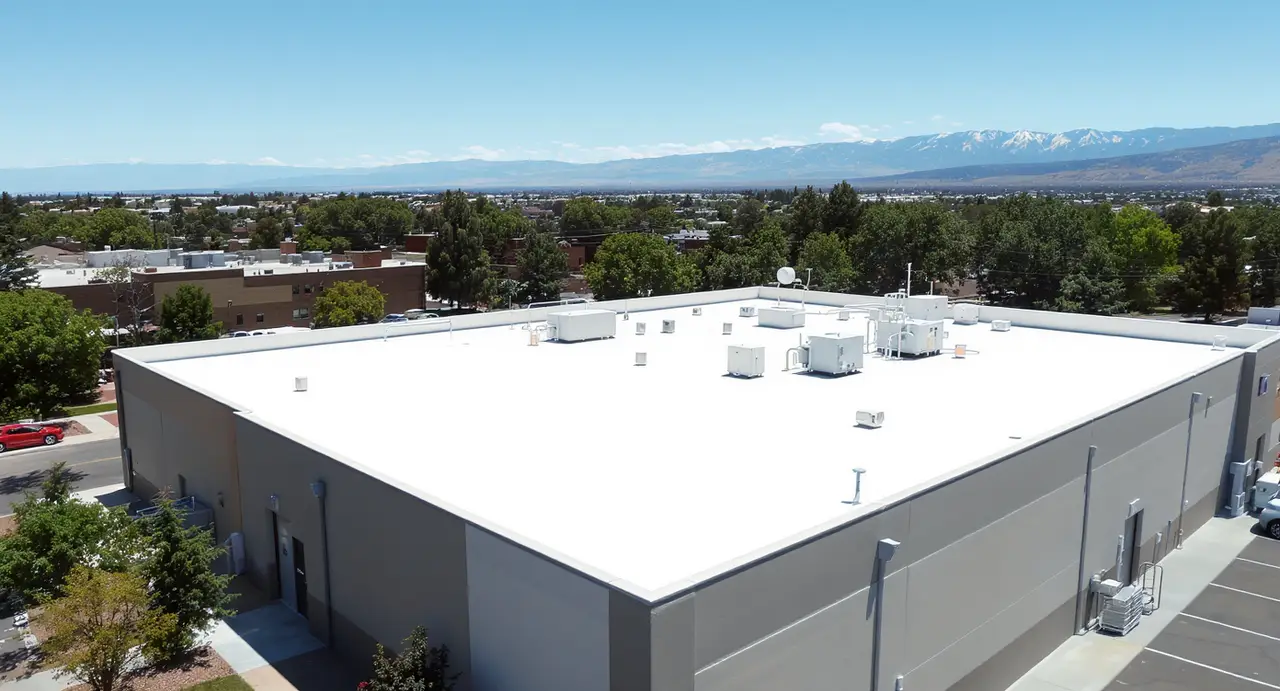
TPO roof installation in Colorado Springs.
TPO is the single-ply membrane most flat and low-slope buildings in this market end up with, and for good reason. It welds into one continuous surface, it reflects a punishing amount of Front Range sun, and when it is installed properly it holds for decades. The catch is in that last part. This page explains what a real TPO installation involves so you can tell a good bid from a cheap one.
Why TPO suits a Colorado Springs roof.
Colorado Springs sits at 6,035 feet. Thinner air means less atmosphere between your roof and the sun, and summer UV index readings here run very high, in the 9 to 11 range. UV is what degrades a membrane, and a bright white TPO surface reflects a large share of it instead of absorbing it. That same reflectivity keeps the roof assembly cooler, which slows thermal cycling — the daily expand-and-contract that works seams loose over time.
Then there is the hail. El Paso County averages seven to ten severe hail days a year, with June consistently the worst month, and severe hail moved through the county again during the June 2026 storm season. A single-ply membrane does not dent the way a metal panel does, but it bruises: hail drives the membrane down into the insulation below and fractures the reinforcing scrim inside it. The surface can look fine from the ground and still be compromised. That is why membrane thickness and the insulation board underneath are not places to save money on a roof in this county.
Winter is the other half of it. Colorado Springs sees roughly 38 to 45 snow days a year, and a flat roof holds snow rather than shedding it. Drainage design and flashing height at the parapets matter more here than they would in a milder climate.

What a TPO installation actually involves.
Most bids describe the same six steps in different words. Knowing what each one is for makes it much easier to see where a low number came from.
Tear-off or recover
The first question is what is under the existing membrane. Dry deck and one existing layer usually means a recover is possible, meaning new insulation and membrane over the old roof. Wet insulation or a second layer means full tear-off. Recovering over trapped moisture is the single most expensive shortcut in this trade.
Deck repair
With the roof open we replace rotted or delaminated decking and correct any structural sag that would create a low spot. This is the part nobody can price accurately in advance, so we quote it as a unit rate and only bill what we actually replace.
Insulation and slope
Polyiso board sets the R-value and, when tapered, builds positive slope toward the drains. Getting water off the roof is the whole game on a low-slope building. Tapered insulation costs more up front and prevents the ponding that ends membranes early.
Membrane attachment
Mechanically fastened, fully adhered, or ballasted. Fastener pattern and spacing follow the wind uplift requirement for the building, which at this elevation and exposure is not a place to interpolate. Perimeter and corner zones get a tighter pattern than the field.
Heat-welded seams
Sheets are welded, not glued. Done right, the seam is stronger than the membrane. Done at the wrong temperature or travel speed, it looks identical and fails within a couple of seasons. Every weld should be probed with a seam tester before the crew leaves.
Flashing and penetrations
HVAC curbs, vents, drains, pipe boots, and the parapet walls. Nearly every leak we are called out to on a membrane roof starts at a detail like these, not out in the open field. Prefabricated corners and boots beat field-fabricated ones almost every time.
What moves the number on a TPO bid.
We will not put a per-square-foot price on this page, because any contractor who gives you one before measuring your roof is either guessing or planning to change it later. What we can tell you is which variables actually move the total, so you can read competing bids properly.
Membrane thickness
Membrane comes in a range of thicknesses. In a hail county the heavier sheet is usually worth the difference, and it is the easiest place for a competing bid to quietly go thin. Check the mil spec on the bid, not just the brand.
Tear-off vs recover
Removing and disposing of an old assembly adds labor and dumpsters. A legitimate recover can take a meaningful share off the total, but only when the existing assembly has been checked and is dry.
Insulation and taper
R-value and whether the insulation is flat or tapered to create slope. Tapered systems are engineered per roof and are the largest single swing factor on most low-slope bids.
Penetrations and detail count
Every curb, drain, vent, and skylight is hand-detailed labor. Two roofs of identical square footage can differ substantially if one is a clean rectangle and the other is covered in mechanical equipment.
Access and staging
Crane or conveyor placement, parking, and how material gets to the roof. A tight site in an occupied commercial district costs more to work than an open lot.
Warranty type
A contractor workmanship warranty and a manufacturer material warranty are different documents covering different failures. Ask which one a bid includes, for how long, and what voids it.
How we quote: We measure the roof, inspect the existing assembly, and write the scope in Xactimate, so if a claim is involved the adjuster is reading the same format. You get itemized line items rather than a single lump sum, which makes it obvious what you are buying and where the optional upgrades are.
When hail is what put you here.
A lot of TPO installations in this county are not planned capital projects. They start with a storm. Severe hail moved through El Paso County during the June 2026 season, and buildings that took it are still working through claims.
Hail damage on a membrane roof is harder to argue than hail damage on shingles, because the evidence is subtle. Impact marks show as soft bruises where the membrane was driven into the insulation, and the fracture is often in the reinforcing scrim inside the sheet rather than on the surface. We inspect the roof, mark and photograph impacts, and write the scope in Xactimate so the adjuster is evaluating the same documentation we are, in the format they already work in.
One thing worth acting on. Commercial claims run on the same Colorado reporting clock as residential ones, one year from the date of loss, and a membrane roof gives you no shingle debris in the parking lot to remind you. If your building took hail this past season and nobody has walked the roof, get it documented while the window is open.
When TPO is not the right answer.
TPO is the default recommendation for a reason, but it is not the only membrane and it is not always the best fit. Roofs that see grease or solvent exposure, such as restaurant kitchen exhaust areas, are usually better in EPDM or a modified bitumen system. Roofs with heavy, constant maintenance traffic hold up better under modified bitumen. And if your building has enough slope to shed water on its own, a standing-seam metal roof will outlive any membrane.
We would rather tell you that at the inspection than sell you the system we happen to be quoting. If TPO is wrong for your building we will say so and explain why. You can see the full range of systems we work with on our commercial roofing page.
Get Your Flat Roof Assessed
Tell us about the building and we'll schedule an inspection and tell you honestly what is up there.
TPO Roofing Questions
There is no honest per-square-foot number we can quote before seeing the roof. Price is driven by membrane thickness, how much insulation the assembly needs, the attachment method, the number of penetrations, and whether the existing roof comes off. We measure the roof, write the scope in Xactimate, and show you the line items so you can see what you are paying for and where you have choices.
Two worth knowing about. TPO is a welded system, so it is only as good as its seams — a crew running the welder too cold or too fast leaves you a roof that looks finished and leaks in two years. And older or thinner membranes have a history of cracking early under UV, which matters more at 6,035 feet than it does at sea level. Both problems are avoidable: specify a heavier membrane, and hire a crew that probe-tests its welds.
They are not really substitutes. Shingles need slope to shed water and are not appropriate on a flat or low-slope deck. If your building has a low-slope roof, the comparison that matters is TPO against EPDM, modified bitumen, or a built-up system, not against shingles. Within that group TPO usually lands in the middle on installed cost and near the top on reflectivity.
Sometimes. A recover, meaning new insulation and membrane laid over the old roof, saves the cost and disruption of a tear-off. Codes limit how many layers a roof can carry, so it is usually only an option over a single existing layer, and it only works if the deck is sound and the existing assembly is dry. If moisture is trapped in the insulation, covering it seals the water in and you pay twice. Moisture in the existing assembly has to be checked before a recover is quoted, and we will tell you honestly when the answer is no.
Properly installed and maintained, a TPO roof is a multi-decade roof. Thicker membrane and clean detail work at the penetrations push you toward the long end of that. Neglect pushes you toward the short end. Ponding water, unrepaired punctures from HVAC service traffic, and clogged drains are what shorten these roofs, not age.
Commercial property policies commonly cover hail and wind damage, and El Paso County sees enough severe hail that this is routine work here. Membrane damage is less obvious than a bruised shingle, so documentation matters — we photograph the roof, mark impact points, and write the scope in Xactimate. Colorado gives you one year from the date of loss to report a claim, so if your building took hail in the June 2026 storms, that window is still open.
Thinking about a TPO roof?
We'll inspect the roof, document what we find, and give you an itemized scope you can actually compare against other bids.
Related Reading
Commercial Flat Roofing Contractors Near Me in Falcon, CO
Need a flat roofing contractor in Falcon, CO? Here's how TPO membrane systems perform in this climate, what they cost, and what to check before hiring.
What Is TPO Roofing? A Plain-English Guide for Building Owners
TPO is a single-ply, heat-welded membrane for flat and low-slope roofs. Learn how it works, what it costs, how long it lasts, and whether it fits a Colorado building.
TPO vs. Metal Roof: Which Is Right for Your Colorado Springs Building?
TPO membrane and standing-seam metal both hold up in Colorado's climate. Compare cost, lifespan, and maintenance to pick the right roof for your building.
How Much Does Flat Roof Replacement Cost in Colorado Springs?
What drives flat roof replacement cost in Colorado Springs: system type (TPO, EPDM, PVC), deck condition, insulation, parapet walls, and the Front Range labor market.