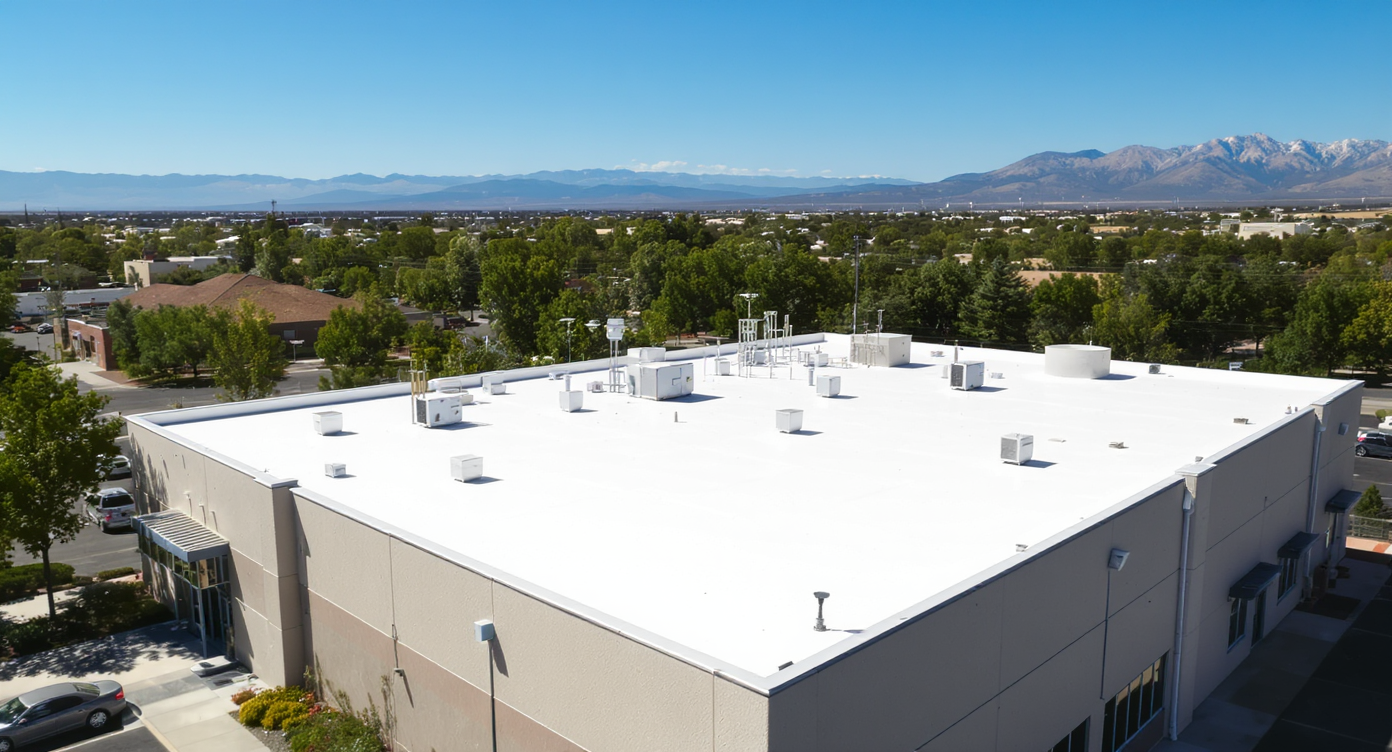
TPO membrane and standing-seam metal are both good roofing choices in Colorado Springs, and the right one depends on your building's slope, budget, and how long you plan to own the property — not on which material is objectively "better." Here's how they actually compare on the factors that matter for a Front Range building.
Roof Slope Determines the Starting Point
Before cost or lifespan, slope decides which option is even on the table. TPO is a single-ply membrane system built for low-slope and flat commercial roofs, where sheets are heat-welded together to form a continuous waterproof surface. Standing-seam metal is designed for slopes of roughly 3:12 or steeper, where panels rely on gravity and interlocking seams to shed water. Try to install metal panels on a near-flat roof and water can pond against the seams instead of running off — a common failure point on improperly specified low-slope metal installs.
Most commercial and light-industrial buildings around Colorado Springs — warehouses, strip retail, office parks — have low-slope roofs, which is why TPO dominates that segment locally. Metal shows up more on steep-slope residential, mixed-use, and buildings where the roof is also a visible design feature.
Cost: TPO Usually Wins Upfront
Material and labor costs vary by project, but the general pattern holds locally: architectural asphalt shingle runs roughly $9.50–$13.00 per square foot installed in Colorado, while standing-seam metal runs $16.00–$22.00 per square foot as of April 2026. TPO on a comparable low-slope application is typically priced closer to the shingle range rather than the metal range, which is one reason it's the default choice for large flat commercial roofs where total square footage makes even small per-foot differences add up fast.
Metal's higher upfront cost is offset by a longer service life. McElroy Metal's life-expectancy data puts standing-seam systems at up to 60 years, compared to the 20–30 years Carlisle SynTec's TPO membrane warranties cover — so the calculation shifts if you're planning to hold the property for decades rather than sell in the next 5–10 years.
Lifespan and Weather Performance in Colorado
Colorado Springs sits at 6,035 feet, and the combination of intense UV, dry air, and freeze/thaw cycling puts real stress on any roofing material. TPO's reflective white membrane handles UV exposure well and helps reduce cooling costs in summer, but seams and flashing details are the weak points — heat-welded seams that were rushed or under-lapped are the most common source of TPO leaks over time.
Standing-seam metal handles UV and freeze/thaw with less degradation, and its concealed-fastener seam design sheds snow load effectively — a real advantage given the Front Range's 38–45 snow days per year. El Paso County also averages 7–10 severe hail days annually, with June the worst month, and hail affects the two materials differently. Metal panels can dent from large hail, which is often cosmetic but can still trigger an insurance claim depending on panel gauge. TPO membrane is more likely to develop a puncture or seam fracture from hail impact — damage that's less visible from the ground but more likely to become an active leak if it isn't caught during a post-storm inspection.
Which One Should You Choose?
If you're managing a low-slope commercial roof and want the lower-cost option with a proven track record, TPO is the standard choice for a reason — it's what most Colorado Springs commercial buildings already have. If your roof has enough slope to support it and you're planning to hold the property long-term, standing-seam metal's longer lifespan can make it the better value over a 30- to 40-year horizon, even at a higher install cost.
Either way, get a contractor who specs the material correctly for your building's slope, elevation, and hail exposure — not whichever product they happen to install most often.
Maintenance to Expect With Each System
Ongoing maintenance looks different for the two systems, and it's worth planning for before you commit. TPO membrane needs a periodic walk-through — at least once a year and after any significant storm — to check seam integrity, flashing at penetrations, and drainage at parapet walls and roof drains. Ponding water anywhere on a TPO roof is worth flagging immediately, since standing water accelerates seam stress over time. Most TPO issues start small and are inexpensive to fix if caught during a routine inspection, but expensive if they're left until a leak shows up inside the building.
Standing-seam metal is lower-maintenance day to day, but it isn't zero-maintenance. Fasteners on exposed-fastener metal systems (less common than standing seam, but still used in some applications) can back out over time and need periodic tightening. Standing-seam panels themselves rarely fail, but flashing at ridges, valleys, and wall transitions is still the weak point — the same as it is on any roof system. A yearly check after Colorado's hail season is worth doing regardless of which material you have.
A note on scope: L&N Construction doesn't install or repair TPO or any other flat or low-slope roof. We work on pitched shingle and metal roofs. If your building has the slope for metal, call (719) 355-0648 or see our commercial roofing page and schedule a free inspection. If it needs a membrane, you need a membrane contractor.
Frequently Asked Questions
Is TPO or metal roofing cheaper to install?
TPO single-ply membrane is generally the lower-cost option for low-slope commercial roofs. Standing-seam metal runs $16.00–$22.00 per square foot installed in Colorado, roughly 40–70% more than architectural shingle at $9.50–$13.00 per square foot — and TPO is typically priced closer to the shingle range for equivalent square footage on a comparable low-slope application.
How long does TPO roofing last compared to metal?
TPO membrane typically lasts 20–30 years depending on membrane thickness and installation quality, per Carlisle SynTec's published TPO warranty data. Standing-seam metal commonly lasts 40–60 years, per McElroy Metal's life-expectancy data, and can outlast the building it's on — which is why metal shows up more often on steep-slope residential and mixed-use projects meant to be a one-time roof.
Can you install metal roofing on a low-slope commercial building?
Standing-seam metal is designed for slopes typically 3:12 or steeper to shed water properly. Most low-slope and flat commercial roofs in Colorado Springs use TPO, EPDM, or another membrane system instead, because metal seams on a near-flat roof are more prone to water intrusion.
Does hail damage TPO or metal roofing worse?
Metal panels can dent visibly from large hail, which is mostly cosmetic but can trigger insurance claims. TPO membrane can suffer punctures or fractures at seams and flashing points from severe hail, which are less visible but more likely to cause an active leak. Both need a post-storm inspection after significant hail.
Which roof type needs less maintenance?
Standing-seam metal generally needs less routine maintenance once installed correctly — mainly periodic fastener and seam checks. TPO membrane needs more frequent inspection of seams, flashing, and penetrations, since heat-welded seams are the most common failure point over the membrane's life.