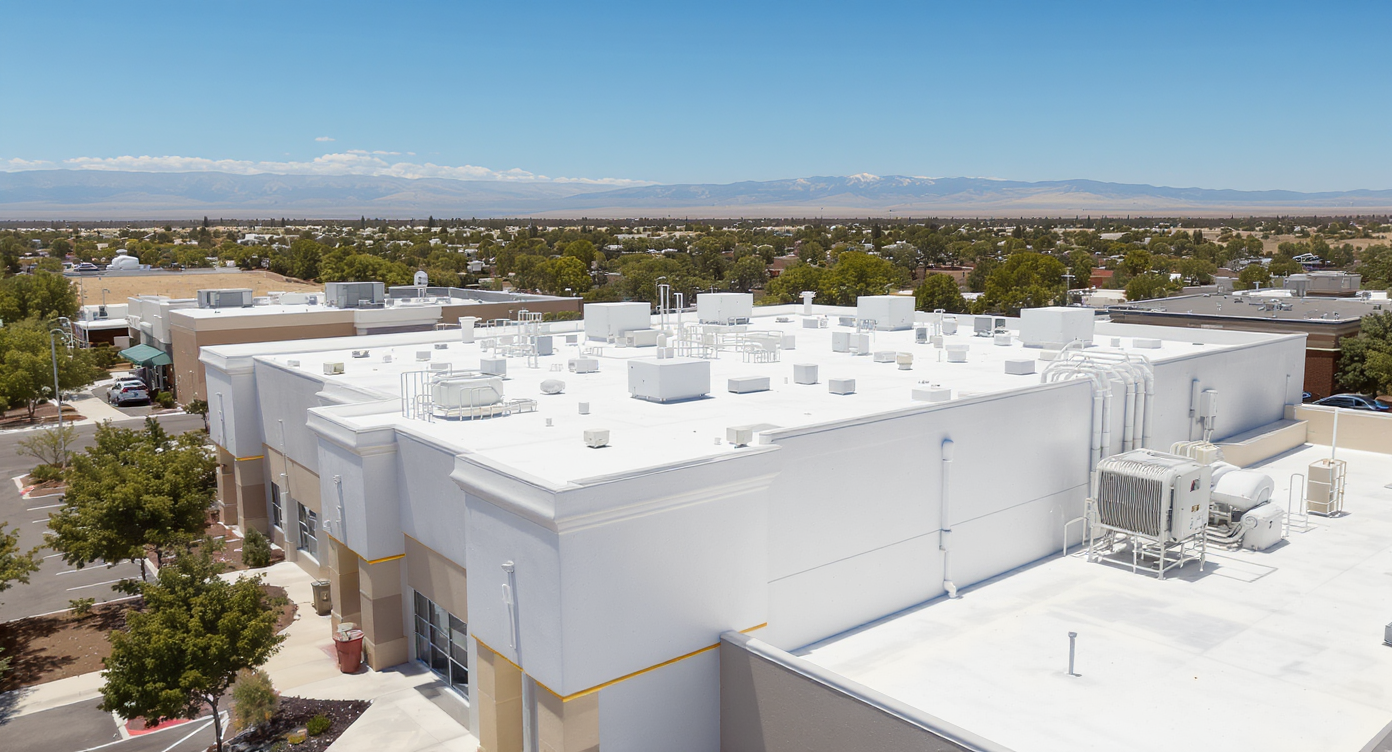
TPO roof sealant is a purpose-formulated accessory product used to seal the three most vulnerable points on a single-ply thermoplastic polyolefin roof: cut membrane edges, T-joint intersections, and the tops of vertical flashing terminations. It is not a coating, not a patch, and not a substitute for heat-welded seams — it is a targeted moisture barrier applied at the specific spots where polyester reinforcement is exposed or where geometry creates a gap that welding alone cannot close.
The Three Types of TPO Sealant and What Each Does
Cut-edge sealant is the most commonly used type. Every time a TPO membrane is trimmed — at the perimeter, around penetrations, or during repairs — the factory edge is lost and the polyester reinforcement scrim inside the membrane becomes exposed. Water can wick into that scrim by capillary action, travel behind the lap seam, and cause delamination or a leak that is difficult to trace. A thin bead of cut-edge sealant, applied with an applicator bottle immediately after trimming, seals that exposure before it becomes a problem.
Major manufacturers each produce their own branded version: Carlisle SynTec makes the TPO Cut-Edge Sealant and a Low-VOC variant for their Sure-Weld membrane system; GAF's EverGuard TPO Cut Edge Sealant covers roughly 100 lineal feet per pint at a 1/8-inch bead; and Holcim Elevate (formerly Firestone Building Products) offers UltraPly TPO Cut Edge Sealant for their UltraPly system. Each is clear and formulated to bond with that manufacturer's specific membrane compound — they are not interchangeable across systems.
T-joint covers and patches address the intersection problem. When two seam lines meet at an angle — one running up a slope and another running across it — they form a T or an L shape. The point where three or four membrane layers converge cannot be fully heat-welded in a single pass. A T-joint cover is a molded patch, typically 3 to 4 inches across, that is heat-welded or pressure-adhered over the intersection. Holcim Elevate's UltraPly QuickSeam T-Joint Covers are pre-applied with pressure-sensitive tape, which speeds installation and reduces torch time at those intersections. The same patch style is also used to repair small punctures in the field membrane. After installing any T-joint cover, the exposed cut edge of the patch itself still receives cut-edge sealant.
Vertical flashing sealant (sometimes called termination sealant) is applied at the top of the termination bar — the metal strip that anchors the edge of vertical TPO flashing against a parapet wall, curb, or transition. The termination bar is mechanically fastened to the substrate, and the TPO membrane is pressed into it. At the very top of that bar, a bead of sealant fills the gap between the bar and the wall surface to block wind-driven water. Henry's Single-Ply Sealant — a 100% solids, solvent-free, one-part polyether product — is one widely used option for this application. Unlike cut-edge sealant, termination sealant needs to stay flexible as the building moves, so polymer formulation matters here.
Why Sealant Fails Faster at High Elevation
In a Colorado Springs commercial roofing environment, TPO sealant takes an outsized beating. The city sits at 6,035 feet, where the UV index climbs into the very high range (9 to 11) during summer. UV is the primary cause of sealant oxidation — it crosslinks the polymer chains, causing brittleness and cracking. Add daily temperature swings that can exceed 50°F between a June morning and afternoon, and the repeated expansion and contraction cycles fatigue sealant faster than the national average.
The result is that cut-edge sealant that might last five or more years in a milder climate may need attention in two to three years here. Any TPO roof maintenance plan on the Front Range should include a sealant inspection every one to two years, not just after storms. Cracked or lifted sealant at seam edges and T-joints is almost always the first failure point before a more serious delamination develops.
What Proper Application Actually Looks Like
Applying cut-edge sealant looks simple — squeeze a bead over a cut edge — but the details matter. The membrane surface must be clean and dry; any silicone contamination from prior repairs renders the sealant useless. The bead should be continuous, with no gaps, and sized to cover the full thickness of the membrane edge. On vertical flashings, the termination bar sealant bead should fill the full cavity above the bar without bridging across so large a gap that it cannot flex.
None of this is complicated for an experienced commercial roofer, but it is easy to skip when time is short. The places most likely to be shortcut — T-joints, cut edges around penetrations, and termination bars at parapet corners — are exactly where leaks eventually appear.
Checking Your Own Sealant Lines
If you manage a commercial property in the Colorado Springs area and want to know the condition of your TPO roof's sealant lines, a visual inspection during dry weather will show you a lot. Chalky residue along seam edges, cracked beads, or sealant that has pulled away from the membrane surface are all signs worth acting on before the next hail season.
A note on scope: L&N Construction doesn't install or repair flat or low-slope roofs (TPO, EPDM, PVC, modified bitumen, built-up or roof coatings). We work on pitched shingle and metal roofs. This guide is general information to help you understand the system and hire the right membrane contractor.
Related Resources
Frequently Asked Questions
How long does TPO cut-edge sealant last?
In normal conditions, cut-edge sealant remains effective for several years. At Colorado Springs elevations — where UV index runs 9 to 11 in summer and temperatures swing 50°F or more between day and night — expect to inspect sealant lines every 1 to 2 years and touch up any that have cracked or pulled away from the membrane edge.
Can I use any sealant on a TPO roof?
No. TPO membranes require sealants formulated to bond with thermoplastic polyolefin. Using a silicone, asphalt-based, or generic caulk will not adhere properly and can contaminate the membrane surface, making future heat-welded repairs impossible. Always use the sealant specified by your membrane manufacturer — Carlisle, GAF EverGuard, or Holcim Elevate — depending on whose system is installed.
Is TPO roof sealant the same as a roof coating?
No. Sealant is a narrow-bead accessory product applied at specific vulnerable points — cut edges, T-joints, termination bars. A roof coating is a flood-applied product that goes over the entire membrane surface, typically to add reflectivity or extend membrane life. They serve completely different purposes.
Do T-joint covers require sealant too?
Yes and no. Fully heat-welded T-joint covers (which are the standard) do not require sealant — the weld is the seal. QuickSeam pressure-sensitive T-joint covers (like Holcim Elevate's UltraPly QuickSeam version) use factory-applied adhesive tape. In either case, cut-edge sealant is still applied to the exposed reinforcement edge of the cover patch itself after installation.
How do I know if my TPO roof sealant is failing?
Look for sealant that has turned brittle, cracked, or pulled away from the membrane edge — especially at T-joints and around penetrations. You may also see a fine white chalky residue along seam lines as the sealant oxidizes. Any cracking at seam edges or vertical flashings warrants a professional inspection before the next rain or hail season.