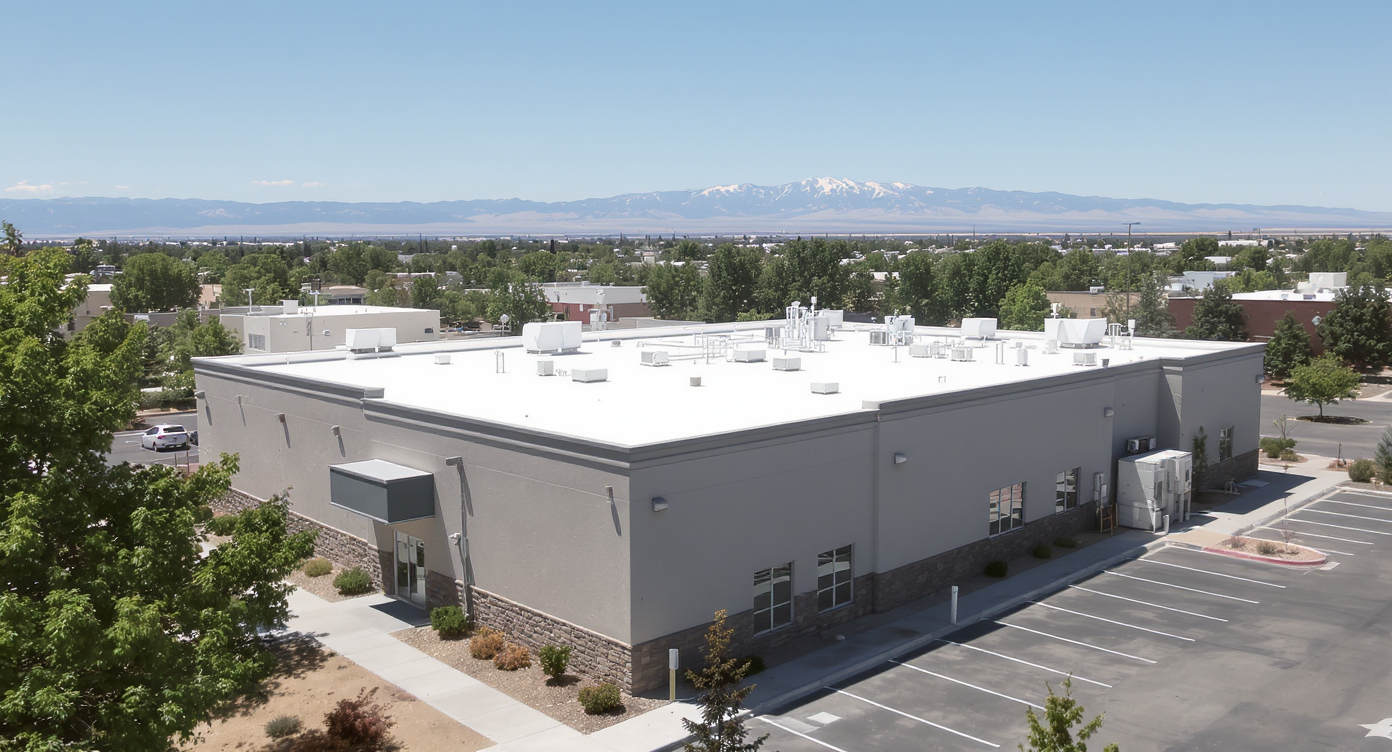
A commercial flat roof in the Falcon area is almost always a TPO single-ply membrane system today, and for good reason — it handles this region's intense summer UV and freeze-thaw winters better than older built-up or modified bitumen systems, at a lower installed cost than standing-seam metal.
Why TPO dominates flat commercial roofing here
Falcon's climate stacks two demands on top of each other: intense high-altitude UV that degrades roofing materials faster than lower-elevation markets, and repeated freeze-thaw cycling that stresses seams and flashing. TPO handles both reasonably well when installed correctly:
- Reflective white membrane reduces heat absorption and UV degradation compared to darker built-up roofing systems.
- Heat-welded seams create a genuinely fused bond rather than an adhesive lap, which holds up better under the expansion and contraction that freeze-thaw cycling causes.
- Lighter weight than built-up gravel systems, which matters for older buildings or structures not engineered for heavier roofing loads.
- Lower installed cost than standing-seam metal, making it the default choice for most low-slope commercial and light-industrial buildings.
What actually determines how long it lasts
Membrane thickness matters, but installation quality matters more. A thicker membrane installed with poorly welded seams will fail faster than a thinner one installed correctly. Before hiring a contractor for a Falcon commercial roof, ask:
- What membrane thickness are you quoting, and is it appropriate for the roof's traffic and equipment load? Rooftop HVAC units and foot traffic areas often need heavier membrane or added protection.
- How do you verify seam welds? A contractor who probe-tests every seam is a different level of quality control than one who eyeballs it.
- What's your parapet and penetration flashing detail? Same as metal roofing, the overwhelming majority of flat roof leaks start at flashing and penetrations, not the field membrane itself.
What kind of buildings need this
TPO flat roofing shows up most often on:
- Light-industrial and warehouse buildings, where low-slope roof design is standard and roof access for HVAC servicing is common
- Retail and strip commercial buildings, where a flat or near-flat roof keeps the building profile low and cost-efficient
- Additions to existing commercial buildings, where matching an existing flat-roof section makes more sense than mixing roof types
If you manage a building with rooftop mechanical equipment, ask specifically about walkway pad protection around service paths — foot traffic concentrated in one area wears a membrane faster than general weather exposure does, and it's a detail some contractors skip on the initial bid to keep the number competitive.
What ongoing maintenance actually looks like
TPO roofs need less maintenance than older built-up systems, but "less" isn't "none." A reasonable annual maintenance visit for a Falcon commercial flat roof checks:
- Seam integrity at a sample of welds, particularly near parapets and equipment curbs
- Drain and scupper clearance, since ponding water shortens membrane life regardless of material quality
- Flashing condition at every roof penetration and parapet transition
- General membrane condition for punctures, especially after a hail event
A facilities team that budgets for this annually avoids the far more expensive scenario of discovering a slow leak has been damaging insulation or the deck below for months.
Falcon-Specific Considerations
Falcon sits within El Paso County, one of the top U.S. counties for hail-related insurance claims, and the region has seen direct severe weather events including the 2023 Falcon tornado outbreak. FM Global roofing standards provide a framework for evaluating wind uplift and hail impact ratings across single-ply membrane systems, which is useful context for facilities managers comparing bids that all claim to meet "commercial grade" specifications. Given the area's hail frequency, we recommend budgeting for post-storm inspections as a standard part of ownership, not an occasional afterthought — membrane punctures from large hail don't always leak immediately, but they don't heal on their own either.
A note on scope: L&N Construction doesn't install or repair flat or low-slope roofs (TPO, EPDM, PVC, modified bitumen, built-up or roof coatings). We work on pitched shingle and metal roofs. This guide is general information to help you hire the right membrane contractor.
Frequently Asked Questions
Why is TPO the standard for flat commercial roofs in the Falcon area?
TPO's reflective white surface handles the region's high-UV summer sun well, its heat-welded seams hold up better than adhesive-only systems under freeze-thaw movement, and it's generally the most cost-effective single-ply option for low-slope commercial buildings here.
How long does a TPO roof last in Colorado?
A properly installed TPO system with quality seam welding is built for decades of service in this climate, though membrane thickness and installation quality both affect real-world lifespan more than any single factor — ask your contractor to spec both, not just the brand name.
Can hail damage a flat TPO roof?
Yes, though differently than shingles. Large hail can bruise or puncture the membrane, particularly around seams or aging areas. Post-storm inspections on flat roofs need someone trained to spot subtle membrane damage, since it doesn't announce itself the way cracked shingles do.
Does L&N Construction work on flat roofs?
No. L&N doesn't install or repair flat or low-slope roofs (TPO, EPDM, PVC, modified bitumen, built-up or coatings). We work on pitched shingle and metal roofs. This guide is general information to help you hire the right membrane contractor.