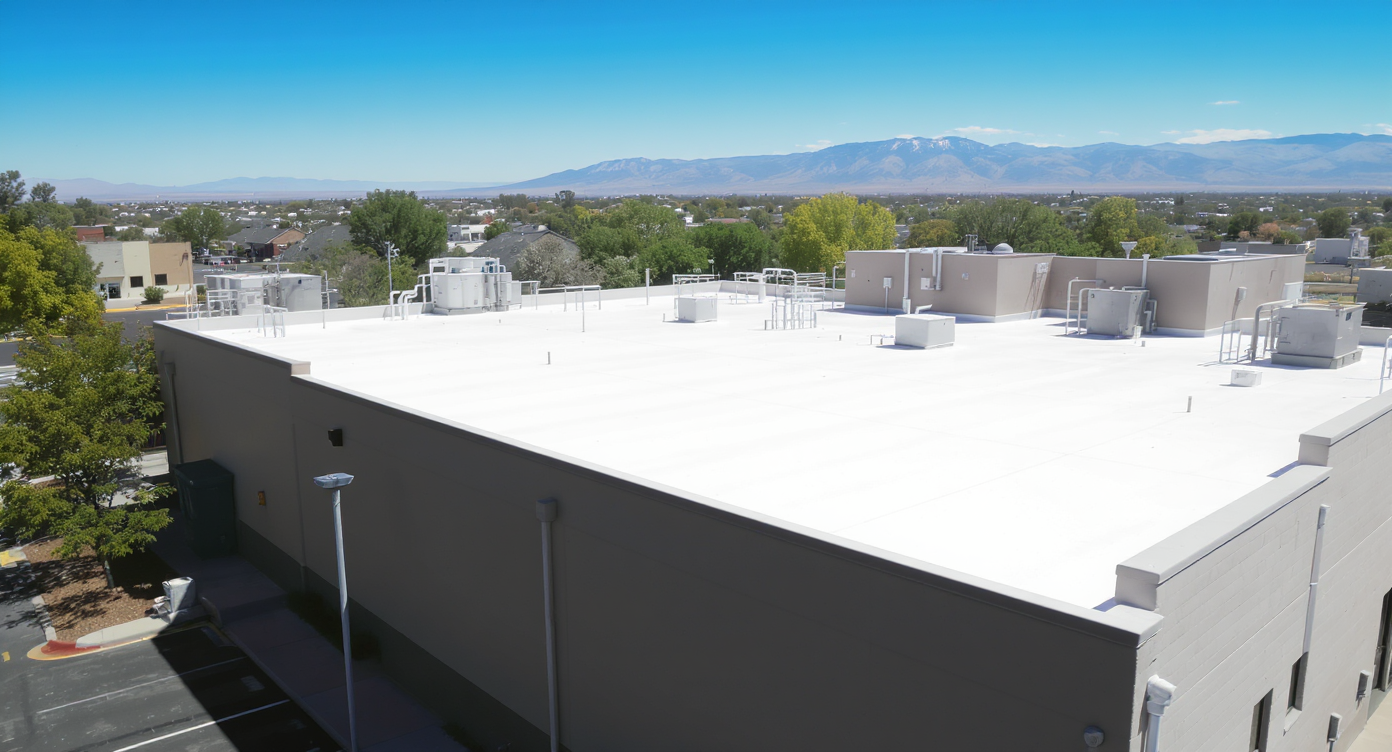
Flat roof replacement in Colorado Springs does not have a simple price-per-square-foot the way asphalt shingles do. The cost depends on which membrane system you choose, how large the roof is, what condition the deck and insulation are in, how the drainage is configured, and how complex the parapet walls and penetrations are. On top of that, Colorado Springs sits in a high-demand Front Range roofing market where hail volume and labor competition push prices meaningfully above what national cost calculators show. Here is what actually drives the number on a flat roof in this market.
The Biggest Variable: Which System Are You Installing?
The membrane system you choose — TPO, EPDM, or PVC — is the single largest driver of material cost and, to a lesser degree, labor cost.
TPO (thermoplastic polyolefin) has become the dominant single-ply flat roofing system on commercial and residential flat roofs in Colorado. It is heat-welded at seams, which produces a continuous monolithic surface that handles the freeze-thaw cycles Colorado Springs sees across its roughly 38–45 snow days per year. White and light-gray TPO also reflects Colorado's intense high-altitude UV — at 6,035 feet, the sun intensity here is measurably higher than at sea level, which shortens the lifespan of any heat-absorbing roof surface. Carlisle SynTec and Firestone Building Products are the leading TPO manufacturers with established warranty programs; material quality and warranty tier vary significantly between budget and premium product lines.
EPDM (rubber membrane) is the other workhorse system. Mechanically fastened or fully adhered EPDM handles Colorado's temperature swings well and has a long track record, but most EPDM is black — which absorbs heat rather than reflecting it. In a high-UV, high-altitude market that already runs warm summers, this matters for both rooftop equipment and energy performance. Seams are adhesive-bonded rather than welded, so seam quality depends more on installer technique.
PVC costs more than TPO or EPDM but is the right call when grease exposure is a concern (restaurants, commercial kitchens) because it is chemically resistant in ways that TPO and EPDM are not. It is also fully heat-welded like TPO. PVC tends to be thicker and carry longer warranty terms at the premium tier.
The installed cost difference between these systems on the same roof can be significant. Get bids that specify the exact membrane manufacturer, thickness (45-mil vs. 60-mil vs. 80-mil), and warranty tier — not just "TPO" or "EPDM."
Deck and Insulation: The Hidden Cost Driver
When a flat roof is removed, what's underneath sometimes changes the entire scope of the job.
Deck condition is often unknown until tear-off. Flat roofs that have held standing water or that have leaked at flashings for years frequently have rotted or delaminated deck substrate. Replacing compromised decking in Colorado typically adds $2.50–$4.00 per square foot of affected area (Xactimate pricing, April 2026) — which can represent a substantial portion of a smaller residential flat roof or an add-on cost on a large commercial scope where 20–30% of the deck turns out to need replacement.
Insulation is the other layer that often surprises property owners. Colorado's energy code for low-slope commercial and mixed-use buildings requires minimum continuous insulation R-values. If the existing insulation is saturated (wet insulation has virtually no R-value), undersized for current code, or simply aged out, it has to be replaced. Tapered insulation — foam board cut to create a deliberate slope toward drains — adds cost but is often the right long-term investment to eliminate the ponding water that degrades every membrane system.
Drainage Configuration
How water gets off the roof matters. Internal drains with roof sumps are common on commercial buildings with parapets but require maintenance and can be expensive to re-route if reroofing changes the slope geometry. Scuppers and overflow scuppers must be properly flashed and sized. Improperly drained flat roofs — where water ponds more than a quarter-inch deep for more than 48 hours after rainfall — violate manufacturer warranty terms on virtually every membrane system and accelerate membrane degradation.
Contractors who scope flat roof work properly will assess drain locations, existing slope (if any), and whether tapered insulation is needed as part of the base estimate, not as a surprise line item after tear-off.
Parapet Walls and Penetrations
Parapet walls — the low walls that extend above the roof surface on commercial and some residential flat roofs — require termination bar installation, counter-flashing, and often coping. The more linear footage of parapet, the more flashing labor. Similarly, HVAC curbs, pipe penetrations, exhaust vents, and skylights all require individual boot or flashing details. A simple 2,000 sqft commercial flat roof with a handful of drains and an HVAC unit costs meaningfully less per square than a roof with multiple curbs, a maze of penetrations, and four sides of tall parapet.
Colorado Springs Market Context
Colorado Springs is in the Front Range pricing tier — baseline market pricing, not a premium mountain market, but not a discount market either. El Paso County consistently ranks among the top US counties for hail-related insurance claims, which keeps contractor demand high and limits labor availability during the May–August convective season. Scheduling flat roof work in late summer or fall typically yields better contractor availability and sometimes better pricing than trying to get a crew in June.
The Front Range also has a meaningful presence of storm-chaser contractors who follow hail events across Colorado and are not locally based. For a flat roof replacement — which requires ongoing warranty support and manufacturer relationships — local, established contractors with direct accounts with membrane manufacturers matter more than on a standard shingle job.
Getting a Useful Estimate
A flat roof estimate that just quotes a lump sum isn't useful for comparison shopping. A proper scope should itemize: membrane system and spec, insulation system and R-value, deck substrate assessment (or a unit price contingency for deck replacement), drain and flashing work, removal and disposal, and warranty tier. If two bids are far apart, the difference is almost always in one of those line items — not arbitrary markup.
A note on scope: L&N Construction doesn't install or repair flat or low-slope roofs (TPO, EPDM, PVC, modified bitumen, built-up or roof coatings). We work on pitched shingle and metal roofs. This guide is general information to help you understand flat roof pricing and hire the right membrane contractor.
If the building also has pitched sections with shingles or metal, those we can help with: call (719) 355-0648 or see our commercial roofing page.
Frequently Asked Questions
How much does flat roof replacement cost in Colorado Springs?
There is no reliable single number because flat-roof pricing depends heavily on system type, roof size, deck condition, insulation requirements, parapet height, and drain configuration. Colorado Springs is a high-demand Front Range market — hail volume and labor competition push pricing above national averages. Get at least two itemized bids from licensed, locally operating contractors rather than relying on national calculator estimates, which routinely run 20–30% low for this market.
What is the difference between TPO, EPDM, and PVC flat roofing systems?
TPO (thermoplastic polyolefin) is heat-welded at seams and reflects UV well — a common choice for Colorado's intense high-altitude sun. EPDM (ethylene propylene diene monomer) is a rubber membrane typically mechanically fastened or adhered; it handles temperature swings well but is typically black, which absorbs heat. PVC is the most chemical-resistant of the three and is fully heat-welded, making it a strong choice around rooftop equipment with grease exposure. Each system has a different installed cost, warranty tier, and expected lifespan.
Does decking condition affect flat roof replacement cost?
Yes, significantly. If the existing roof deck — typically OSB or concrete board — has rotted, delaminated, or been compromised by long-term moisture, it must be replaced before a new membrane goes down. Decking replacement in Colorado typically adds $2.50–$4.00 per square foot of affected area (as of April 2026, Xactimate pricing). A flat roof that has leaked for years can have extensive deck damage that only becomes visible once the old membrane is removed.
Does Colorado code require anything specific for flat roofs?
Low-slope commercial roofs in Colorado must meet energy code minimum R-value requirements for continuous insulation, which varies by jurisdiction and building type. Drainage must be designed to prevent ponding water, which degrades any membrane system. Perimeter and penetration flashing must be detailed per manufacturer specs to maintain the warranty.
How do I know if my flat roof needs replacement versus repair?
Repairs make sense for isolated punctures, seam failures, or flashing problems on a membrane that is otherwise intact and not past its service life. Replacement is usually the right call when the membrane is alligatored, shrinking, or delaminating, when multiple leaks are spread across the field of the roof, when ponding water has been standing for years, or when the insulation layer is saturated. A thorough moisture survey — including infrared scanning where warranted — gives a clearer picture than a visual inspection alone.