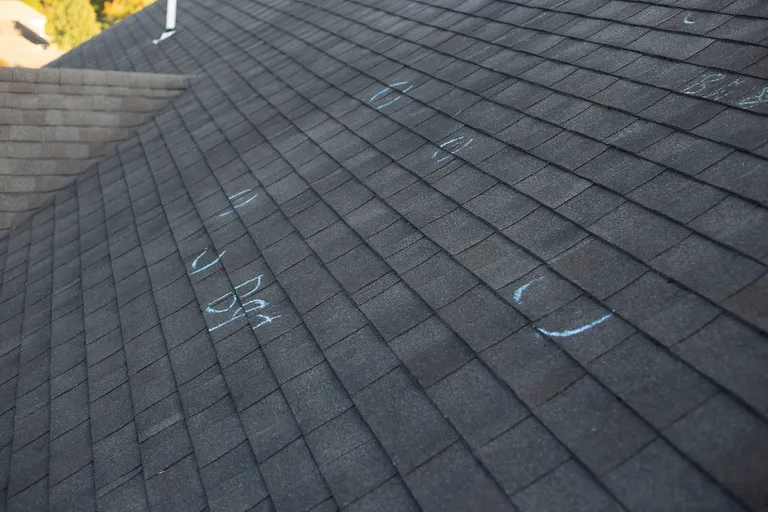
Hail damage siding repair in Colorado Springs.
Hail does not stop at the roofline, but claims often do. L&N acts as the general contractor on full-property storm claims — we write the whole scope, including the elevations, and bring in the siding trades to do that part of the work. Roofing is what our own crews perform. This page is about the siding half of a hail claim and why it so often goes unpaid.
Why siding is the part of the claim that gets left out.
A storm inspection is usually a roof inspection. The contractor goes up, the adjuster goes up, and the conversation happens on the shingles. The elevations get a walk-around from ground level, which is the one vantage point from which hail damage to siding is hardest to see. Cracks in vinyl frequently run behind the overlap of the course above, and dents in aluminum or steel only read at a low angle in raking light.
Direction compounds it. Hail arrives on the wind, so it hits elevations rather than falling evenly. A house can have a north wall that is untouched and a west wall that is comprehensively damaged, and if the walk-around started on the wrong side and the weather was overcast, that gets written up as a roof-only loss.
The consequence is not cosmetic. Your policy insures the dwelling, and roof and siding damage from one storm is one loss under one deductible. Damage that stays out of the scope does not become a second claim later — it becomes repairs you pay for yourself, having already paid the deductible on the roof.

What hail does to each cladding.
Each material fails differently, which is why a single mental picture of “hail damage” misses most of it. Walk your own elevations with these in mind before anyone else does.
Vinyl
Cracks and punctures rather than dents, and gets more brittle as temperature drops — an early-season storm can do disproportionate damage. Look at the lower courses, around window trim, and behind the overlap where a split hides in shadow.
Aluminum and steel
Dents. On a flat panel a dent is obvious; on a textured or wood-grain finish it reads as nothing at all until you look along the wall from the corner in low sun. Chipped or fractured paint film around an impact is the tell that matters for coverage.
Fiber cement
Takes impact better than most, and when it does fail it chips at the edges and butt joints or cracks through the plank. The damage is often at the caulked joints rather than in the field, which is where water gets behind the cladding.
Stucco
Pockmarks and hairline cracking, sometimes with the finish coat spalled away in a scatter pattern that matches the storm direction. Easy to attribute to age. The distinguishing feature is that it appears on the storm-facing elevations and not the others.
Wood and engineered wood
Bruising and split grain, and on engineered products, a broken paint film that lets moisture into the substrate. This one degrades fastest after the storm, so documenting it early matters more than it does on vinyl or steel.
Trim, wraps and accessories
Fascia wrap, soffit, window and door wraps, shutters, vents and light fixtures. Cheap individually and routinely omitted from a scope. Collectively they are a real number, and they are also the clearest corroborating evidence that hail hit that elevation at all.
How the siding portion actually gets done.
We are a roofing company that runs full-property storm claims as general contractor. On the roof, our own crews do the work. On the elevations, we contract siding trades and manage them — scope, sequencing, materials, site condition and sign-off all sit with us, on one contract, against one claim.
We say that plainly because the alternative arrangement is worse for you and common in this market: two separate contractors, two scopes written against the same deductible, and nobody responsible for the seam where the roof edge meets the wall. That seam, meaning drip edge, fascia, the top course of siding and gutter attachment, is where storm restorations go wrong, and it only stays right when one party owns both sides of it.
Both surfaces in the same visit
The roof and every elevation get documented together, with photographs marked by orientation so the storm direction is legible in the file rather than argued about later.
Walls in the same estimate as the roof
Roof, siding, gutters, wraps and accessories go into a single Xactimate scope. One document, one deductible, no second claim to open later.
Trades sequenced, not colliding
Roof edge, gutters and the top course of siding have to be coordinated. When the trades are under one contract they run in order instead of undoing each other.
You call us, not a sub
If something is wrong at the end, you call the company you hired. We have been operating in Colorado Springs for 15 years and we are insured.
To be clear about what we are: L&N is a roofing contractor that acts as general contractor on storm claims. We are not a siding installation company and we do not present ourselves as one. Siding is in scope because hail claims include it, and it is delivered by trades working under our contract.
The argument that decides a siding claim.
On a roof, a partial repair is usually invisible from the street. On a wall it is not. The question that determines the size of a siding settlement is almost always the same one: can the existing product still be obtained, and if a near-match is substituted, is the result acceptable?
Colorado policies typically promise replacement with materials of like kind and quality, and Colorado courts have interpreted that contract language to support matching where it is ambiguous. That is a contract and case-law position rather than a statutory guarantee, which means it is won or lost on documentation: the manufacturer and profile of what is on the house, whether it is still made, and what a substitute actually looks like next to twenty-year-old weathered cladding.
We document that at the inspection rather than raising it after a partial approval lands. If you want the wider picture of how settlements are structured — actual cash value, recoverable depreciation, deductibles and deadlines — that is on our claim assistance page, and the full process runs on our insurance claims page.
When this is not the right page for you.
This is storm claim work. If you want to re-side a house as a straight remodel, with no storm loss behind it, we are not the right call and we will say so in the first two minutes rather than the third meeting. Likewise if the only damage is a handful of cracked panels on one elevation and your wind and hail deductible is a percentage of dwelling coverage, which many Colorado policies now carry, the claim may simply not be worth opening. We will run that arithmetic with you honestly, including when the answer costs us the job.
What we are good for is the case where a real storm hit the whole envelope and the scope came back roof-only. That is the situation this page exists for, and it is far more common in this county than it should be.
Get the Whole House Looked At
Tell us when the storm was and we'll inspect the roof and every elevation in the same visit.
Hail and Siding Questions
Commonly, yes. A homeowners policy insures the dwelling, not just the roof, so hail damage to siding, gutters, fascia and wraps is normally part of the same loss under the same deductible. The practical problem is that siding damage is frequently left out of the initial scope, because adjusters walk the roof first and the elevations get a shorter look. If it is not in the scope, it does not get paid for.
Yes, and it is one of the more vulnerable claddings. Hail cracks and punches through vinyl rather than denting it, and vinyl gets more brittle in cold weather, so a spring storm can do more to it than a summer one. Damage often shows on the lower courses and around windows first, and cracks running behind the overlap of the course above are easy to walk straight past.
It depends on whether the existing product can still be matched. Siding profiles and colors are discontinued constantly, and a partial repair in a near-match is visible from the street. The case for replacing a full elevation rests on the like-kind-and-quality language in your policy, and it is built by documenting the existing product, not by asking nicely.
No. L&N acts as the general contractor on full-property storm claims and brings in siding trades to do that portion of the work under our contract and supervision. Roofing is what our own crews do. We are transparent about that arrangement because it is the honest description of how the job runs, and because it is the reason the roof and the siding end up on one coordinated schedule rather than two.
One year from the date of loss to report the claim to your insurer. Siding is where that bites hardest. A homeowner notices a leak from a damaged roof within a season but can live next to cracked siding for two years without registering it, and by then the reporting window has closed on the whole loss, roof included. The June 2026 storms are still inside the window until June 2027.
Fiber cement and steel generally take impact better than vinyl, and both are heavier and more expensive to install. There is no cladding that is immune in this county — El Paso County averages seven to ten severe hail days a year. If your claim is paying to replace an elevation anyway, that is the moment to have the conversation about upgrading the product, because the difference in cost is much smaller when the labor is already covered.
Was your siding left out of the scope?
We'll document every elevation and show you what is missing from the estimate you were sent.
Related Reading
What to Know About Damage Repair Roofing in Colorado Springs
Learn what Colorado Springs homeowners need to know about damage repair roofing — hail, snow, freeze-thaw, insurance claims, and how to vet a local contractor.
What Does Hail Damage Actually Look Like on an Asphalt Shingle Roof? (Monument, CO Guide)
See what real hail damage looks like on asphalt shingles vs. cosmetic marks, and why Monument's spot on the Palmer Divide makes this worth checking after storms.
Roof Inspection Near Me in Peyton, CO: What It Covers and When to Book
A free roof inspection in Peyton, CO takes 45–60 minutes and checks shingles, flashing, and vents for hail and wind damage. Learn when to book one and what it covers.
Hail Damage Roof Insurance Claim in Security-Widefield, CO: A Homeowner's Guide
How to file a hail damage roof insurance claim in Security-Widefield, CO: deductibles, deadlines, like-kind matching, and how to keep your claim scope complete.