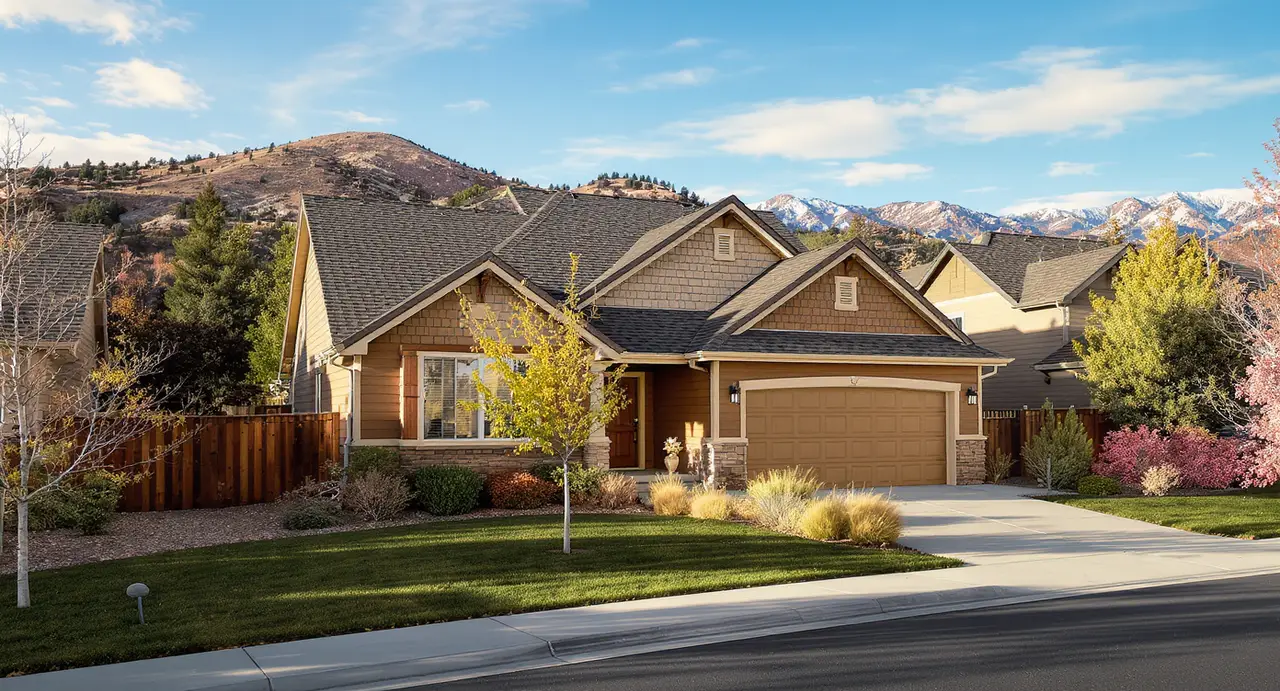
Roof insurance claim assistance in Colorado Springs.
Most homeowners can follow the steps of a claim well enough. Where it goes wrong is the paperwork: what your first check actually represents, why the deductible is bigger than you expected, and what the policy language obliges your carrier to do. This page explains the money side of a roof claim so you can read your own settlement instead of taking someone's word for it.
Your first payment is not the settlement.
The single most common misunderstanding we see is a homeowner opening the first insurance check, comparing it to a roofing bid, and concluding the claim will not cover the job. On a replacement cost policy it was never supposed to. That first payment is actual cash value — replacement cost minus depreciation for the age and wear the roof already had.
The withheld amount is called recoverable depreciation, and the word that matters is recoverable. When the work is complete and the final invoice goes to the carrier, that money is released. Skip the work, or let a contractor shortcut the scope to match the first check, and you never see it. On an older roof the depreciation withheld can be a large share of the total.
Some policies are actual cash value only, with no recoverable component. That is a different situation and it changes what is worth doing. Know which kind of policy you hold before you decide anything. It is stated on your declarations page, and if you cannot find it we will look at it with you.

The five places a claim usually goes sideways.
Not the whole process — for that, see our insurance claims page. These are the specific decision points where an informed homeowner ends up with a materially different outcome than an uninformed one.
Reading the scope line by line
Carrier estimates are itemized, and items get left out — ridge, drip edge, ice and water barrier, ventilation, or the second layer nobody knew was up there. We compare the carrier scope against what the roof actually needs and identify what is missing before the work starts, not after.
The deductible conversation
Colorado wind and hail deductibles are frequently a percentage of dwelling coverage rather than a flat amount, so the number surprises people. We work out what you will actually owe up front. What we will never do is offer to absorb it — that is fraud, and it is the fastest way to lose a claim.
Recovering the depreciation
The withheld depreciation on a replacement cost policy is released against a completed invoice. That means the invoice has to match the approved scope and the work has to be finished and documented. This is administrative rather than difficult, and it is where money is most often left behind.
Matching and like kind and quality
When only one slope is damaged, the question is whether the rest can be matched. Colorado policy language typically promises materials of like kind and quality, and the strength of the argument depends on the discontinued products and color variation we can document on your specific roof.
Partial approvals and repair-only decisions
Carriers sometimes approve a repair where a replacement is warranted. Sometimes they are right. When they are not, the response is more documentation, not more argument — additional test squares, better photography, and a clear written explanation of why a spot repair will not perform.
Knowing when not to file
A claim on a roof with cosmetic granule loss and no functional damage can cost you more in premium than it returns. We will tell you when the honest answer is to leave it alone and re-inspect after the next storm. That conversation costs you nothing and it happens often.
What Colorado rules actually say — and what they don't.
There is a lot of confident misinformation in this market about what the law obliges your insurer to do. Some of it comes from contractors repeating what they heard on a sales call. Here is the honest version, with the distinctions kept straight.
Matching is a contract argument
Colorado policies typically promise replacement with materials of like kind and quality, and Colorado courts have interpreted that language to support matching where it is ambiguous. It rests on your policy wording and case law — not on a statute that guarantees it.
CRS 10-4-120 is about choice, not matching
That statute governs a consumer's choice of repair business and the anti-steering disclosures an insurer owes you. It is regularly and incorrectly cited as the basis for material matching. Anyone quoting it that way is telling you something the statute does not say.
Prompt payment has rules
The Colorado Division of Insurance enforces prompt-payment requirements under Title 10, Article 3, Part 10. If a claim is sitting with no acknowledgement or no decision, that is not simply how it goes — there are timelines your carrier is working under.
The reporting deadline is one year
One year from the date of loss to report it to your insurer. The window to actually file is usually longer, commonly two years, but a missed reporting deadline ends the claim outright.
The deductible is always yours
No exception, no arrangement, no creative estimating. A contractor who offers to cover it is committing insurance fraud and exposing you along with themselves.
We are not public adjusters
We document damage, write scopes, meet adjusters on the roof, and explain what we are seeing. We do not negotiate your claim on your behalf or give legal advice. Where you need a public adjuster or an attorney, we will say so plainly.
How we document: We write scopes in Xactimate, which your adjuster is already using. That does not guarantee agreement, but it removes the arguments that come from two parties pricing the same roof in two different formats.
The one date worth putting in your calendar.
El Paso County averages seven to ten severe hail days a year, June is consistently the worst month, and severe hail moved through the county again during the June 2026 storm season. Plenty of roofs took damage that their owners have not looked at, because from the ground a bruised shingle looks like a shingle.
The reason that matters is the clock. In Colorado you have one year from the date of loss to report a claim to your insurer. A June 2026 loss has to be reported by June 2027. Miss that and the condition of your roof stops being relevant — there is no claim to argue about.
An inspection costs you nothing and settles the question either way. If there is no functional damage we will tell you so and you can stop thinking about it. If there is, you will have it documented while the window is still open rather than discovering it the following spring when a leak makes the decision for you.
What we will not do.
We will not tell you to file a claim on a roof that does not have a claim in it, and we will not sign you to a contract before your adjuster has been out. Both are standard practice for the crews that arrive in this county after a storm and leave before the next one. We have been working in Colorado Springs since 2011 and we are still here when the warranty gets tested. That only counts for something if we behave that way in the first conversation.
We also will not promise you an outcome. Nobody who has actually worked claims will. What we can promise is that the damage will be documented properly, the scope will be written in the format your carrier uses, and you will understand what you are looking at before you sign anything. If you want the full step-by-step of how a claim runs from inspection to final invoice, that is on our insurance claims page.
Have a Claim You Don't Understand?
Send us what your carrier sent you. We'll read it with you and tell you honestly what it says.
Claim Assistance Questions
Actual cash value — the replacement cost of your roof minus depreciation for the age and wear it already had. On a replacement cost policy, ACV is only the first payment. The depreciation that was withheld is recoverable: once the work is finished and the final invoice goes to your carrier, they release it. Homeowners who do not know that money is recoverable sometimes settle for the first check and leave a substantial amount on the table.
Because many Colorado policies carry a separate percentage-based wind and hail deductible rather than a flat dollar amount. Standard HO-3 policies in this state commonly sit at 1 to 2 percent of the dwelling coverage, and some carriers moved to separate wind and hail deductibles in the 2 to 5 percent range after 2018. It is a percentage of what your house is insured for, not of the roof, so it can be several times larger than the deductible you are used to seeing.
Colorado policies typically promise replacement with materials of like kind and quality, and Colorado courts have read that contract language to support matching where the wording is ambiguous. That makes it a contract and case-law argument, not a statutory guarantee — which is exactly why it comes down to how the damage and the existing materials are documented. We will tell you honestly whether your situation is a strong matching argument or a weak one.
They can suggest a contractor from their own recommended list. Choosing one is your decision. Colorado law addresses consumer choice of repair business and requires anti-steering disclosures from insurers under CRS 10-4-120. Note that this statute is about who does the work, not about material matching — the two get conflated constantly, including by contractors who should know better.
You have one year from the date of loss to report a claim to your insurer, so June 2026 hail has to be reported by June 2027. Filing the claim itself typically has a longer window, commonly two years, but the reporting deadline is the one that quietly ends claims. If your roof took hail this past June and nobody has looked at it, the window is open and closing.
No, and neither can anyone else. Your deductible is a contractual obligation between you and your carrier and it is always yours to pay. A contractor offering to absorb it, discount it, or bury it in the estimate is proposing insurance fraud and putting your claim at risk along with their own business. Treat that offer as a reason to end the conversation.
Not sure what your settlement covers?
We'll inspect the roof, compare it against the carrier scope, and show you the difference in writing.
Related Reading
Roof Insurance Claim Help in Colorado Springs, CO
Hands-on roof insurance claim help for Colorado Springs homeowners — deductibles, RCV vs ACV, supplements, and adjuster meetings. Xactimate estimates from L&N Construction. Call (719) 355-0648.
Hail Damage Roof Insurance Claim in Security-Widefield, CO: A Homeowner's Guide
How to file a hail damage roof insurance claim in Security-Widefield, CO: deductibles, deadlines, like-kind matching, and how to keep your claim scope complete.
Roof Replacement Near Fountain Creek Regional Park, Fountain CO
Roof replacement for homes near Fountain Creek Regional Park in Fountain, CO. Local pricing, hail-driven insurance claims, and honest Xactimate estimates.
What to Know About Damage Repair Roofing in Colorado Springs
Learn what Colorado Springs homeowners need to know about damage repair roofing — hail, snow, freeze-thaw, insurance claims, and how to vet a local contractor.