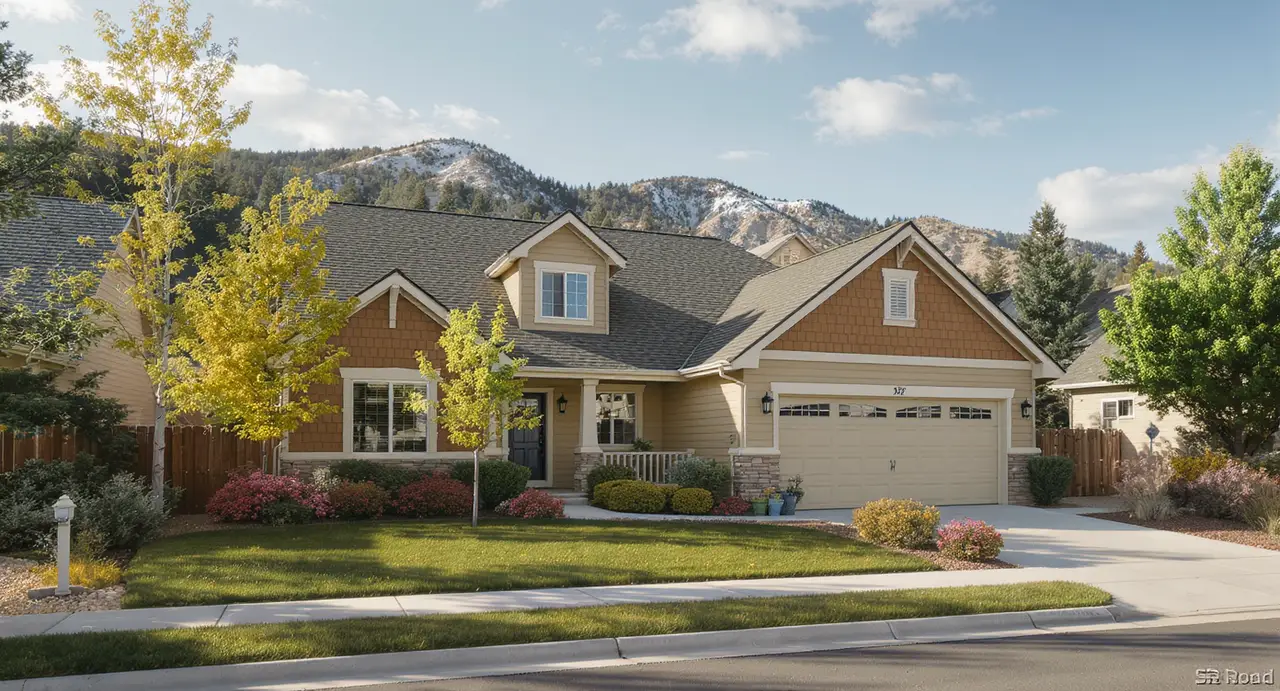
Flat and low-slope roof systems in Colorado Springs.
A low-slope roof does not shed water. It manages it. That one difference changes every decision that follows — the covering, the insulation, where the drains go, and how the edges are detailed. This page walks through the four systems we install on low-slope decks, what each one is actually good at, and how to work out which belongs on your building.
Where a roof stops being a shingle roof.
Roughly two units of rise for every twelve of run. That is where shingle manufacturers generally draw the line. Above it, water moves fast enough that overlapping shingles shed it before it can work sideways under a lap. Below it, water sits, creeps, and eventually finds any joint you gave it. Just above the line is a gray zone where shingles can work but only with extra underlayment and careful eave protection. Under it, shingles are the wrong product no matter how well they are nailed.
That is why low-slope roofs use membranes and fully sealed assemblies instead. The goal changes from shedding water to holding a continuous waterproof surface and giving the water somewhere deliberate to go. Almost nothing that is called a flat roof is truly level — it is built with a slight fall toward drains or scuppers, and when that fall is missing or has been flattened by a sagging deck, you get ponding.
Low-slope decks turn up on far more Colorado Springs buildings than people expect. Commercial and light-industrial buildings are the obvious ones. But so are additions, porch and carport roofs, dormer tops, second-story deck surfaces, and the mid-century homes around the older parts of town that were designed with genuinely flat rooflines. Same physics, smaller area.

Four systems, and what each is actually good at.
Most contractors install one of these and describe the other three as compromises. They are not. They are different tools, and the differences are easy to explain once someone bothers to.
TPO
Single-ply, heat-weldedThe default on most new low-slope work, and usually the right call. Sheets are welded into one continuous surface, and the bright white finish reflects a large share of the sun rather than absorbing it. Its weak point is workmanship — the seams are only as good as the welder operating the machine.
EPDM
Single-ply rubber, adhesive-seamedDark rubber membrane, seamed with adhesive tape rather than heat. It tolerates grease and solvent exposure far better than TPO, which makes it the sensible answer around restaurant kitchen exhaust. Being dark, it absorbs heat instead of reflecting it — a drawback in summer, occasionally an advantage in snow.
Modified bitumen
Multi-ply, torch or self-adheredAsphalt sheet reinforced with polymer, installed in layers. The thing it does better than any single-ply is take abuse. If your roof has equipment that gets serviced monthly and people walking the same path across it, mod-bit holds up where a thin membrane gets scuffed and eventually punctured.
Built-up roofing
Alternating felt and asphalt, gravel surfacedThe oldest system still in regular use — layers of felt and asphalt built up on site and usually topped with gravel. Heavy, slow, and genuinely difficult to damage. You will find it on a lot of older Colorado Springs buildings, and when the deck can carry the weight it remains a defensible choice.
If your building is heading toward single-ply — which most do — the TPO installation page goes considerably deeper on membrane thickness, attachment methods and how to read a welded-seam spec on a bid.
What actually ends a flat roof in this county.
It is rarely the membrane wearing out. A handful of things do most of the damage here, and most of them are drainage problems in disguise.
Ponding water
Water still sitting on the roof two days after it stopped raining is a defect, not a quirk. It loads the deck, accelerates membrane degradation, and grows a biological layer that hides the puncture underneath it. Ponding is almost always a slope problem, and slope problems are solved with tapered insulation, not with more sealant.
Snow that has nowhere to go
Colorado Springs sees roughly 38 to 45 snow days a year. A pitched roof sheds most of that; a flat roof holds it, then melts it slowly into drains that may be frozen. Drain placement, overflow scuppers and adequate flashing height at the parapet matter far more here than in a mild climate.
UV at 6,035 feet
Colorado Springs sits at 6,035 feet, with less atmosphere between the roof and the sun than lower markets get. Summer UV index readings run very high, in the 9 to 11 range. UV is what breaks down a membrane chemically, and it is the strongest argument for a reflective surface and a heavier sheet on a roof at this elevation.
Hail, and what it hides
El Paso County averages seven to ten severe hail days a year, with June consistently the worst month. Hail on a membrane does not read as obvious damage the way a bruised shingle does — it drives the sheet down into the insulation and fractures the reinforcement inside it. The surface can look intact and still be finished.
Traffic nobody accounted for
HVAC techs, antenna installers, window cleaners. Every trade that goes up there walks the shortest line between the hatch and their equipment, month after month. Walkway pads along that line cost very little and prevent the single most common puncture we get called out to.
Detail work at the edges
Curbs, drains, pipe boots, skylights and parapet walls. Nearly every low-slope leak we are called to starts at a detail, not out in the open field of the roof. Prefabricated corners and boots outperform field-fabricated ones on almost every roof we open up.
How we work out what your roof needs.
A low-slope roof cannot be assessed from the ground or from a photograph, and the important information is under the surface rather than on it. Before anyone quotes it, the existing assembly has to be checked: how many layers are up there, what the insulation is, whether it is wet, and what condition the deck is in. That decides whether you are looking at a recover or a full tear-off, and it is the difference between a realistic number and a hopeful one.
Then we map where the water goes. We look at drain locations against the low points, check for standing water or the stains it leaves behind, and work out whether the roof needs tapered insulation to rebuild a fall it has lost. Rebuilding slope costs more up front than any other line on the estimate and prevents the failure mode that ends most of these roofs early.
We write the scope in Xactimate, itemized, rather than handing you a lump sum. That matters here more than on a shingle roof, because low-slope bids differ from one another in ways a single number completely hides. Two contractors can quote the same roof and one has left out the taper, the walkway pads, and half the flashing detail.
If it is one flat section on a pitched house.
This is worth its own paragraph because it is the version of the problem most homeowners actually have. An addition off the back. A carport. A porch roof. A flat deck over a garage. It is a small area, so it gets treated as an afterthought on a shingle bid — and it is where the leak is, every time.
The failure is almost always at the transition, where the low-slope section meets the pitched roof or a wall. That junction takes all the water coming off the larger roof above it and needs to be flashed as a proper termination, not caulked. We treat those sections as membrane work with a detailed tie-in, because that is what they are, and we would rather do the small job correctly than come back for the ceiling repair.
Whichever system your building ends up with, you can see the full range of what we do on low-slope and commercial buildings on our commercial roofing page.
Get the Low-Slope Roof Looked At
Tell us about the building and we'll come out, look at what is up there, and tell you honestly which system belongs on it.
Flat Roof Questions
Structurally a deck can be dead flat, but shingle manufacturers set a minimum pitch, and their minimums generally put the line around two units of rise per twelve of run. Below that, shingles are not an appropriate covering, because water moves too slowly to shed before it finds a lap joint, and the roof needs a membrane or a fully soldered metal system instead. Most decks called "flat" are actually built with a slight pitch toward drains. Nothing on a building should be truly level.
Mostly a rule of thumb used on repairs: if more than about a quarter of a roof needs work, tearing off and starting over usually costs less over the life of the roof than patching. Some states also have a code version of it that forces a whole-roof upgrade past that threshold, but Colorado has no statewide rule and your local building department decides what applies. On a low-slope membrane the rule of thumb matters more than on shingles, because patching means cutting into a continuous waterproof surface and reintroducing seams that were not there before. Every patch is a new place for water to try.
There is no single answer, which is why this page compares four of them rather than selling one. TPO suits most buildings. EPDM handles grease and chemical exposure better. Modified bitumen holds up under maintenance foot traffic. A built-up roof is heavy and slow to install but very hard to hurt. The right choice depends on what is on your roof, who walks on it, and what is under the deck.
Cheaper to frame, usually more expensive to maintain. A flat deck uses less structure and less roofing material for the same building footprint. It also has no gravity assist, so drainage design, insulation slope, and flashing detail carry the whole load. Over the life of the building the framing savings and the maintenance costs tend to cancel out.
We do, and it is worth calling it out because it falls between trades. Additions, dormer tops, porch and carport roofs, and second-story decks are often low-slope sections tied into a shingle roof. The failures almost always start at that tie-in, not out in the middle. A shingle crew that flashes it like a normal wall junction will leave you a leak that reappears every spring.
Decades, for a well-installed system that gets looked at. What shortens it here is not usually age. It is standing water that never drains, unrepaired punctures from equipment service traffic, and drains left blocked through a winter when the roof is holding snow. Colorado Springs sees roughly 38 to 45 snow days a year, and a flat roof holds all of it.
Not sure which system your roof needs?
That is the normal starting point. We'll inspect it, document what we find, and give you an itemized scope you can actually compare against other bids.
Related Reading
Commercial Roofing Companies Near Me in Colorado Springs: How to Choose
Choosing a commercial roofing company in Colorado Springs, CO? Learn what credentials, systems, and warranties matter for flat and low-slope roofs in a hail-heavy market.
What Is Commercial Roofing?
Commercial roofing uses flat and low-slope membrane systems — TPO, EPDM, BUR — that differ from residential in slope, drainage, materials, and codes.
What Is TPO Roofing? A Plain-English Guide for Building Owners
TPO is a single-ply, heat-welded membrane for flat and low-slope roofs. Learn how it works, what it costs, how long it lasts, and whether it fits a Colorado building.
What Is a TPO Roof? A Plain-English Guide for Colorado Springs Property Owners
TPO is a single-ply thermoplastic membrane used on flat and low-slope roofs. Learn how it works, how long it lasts, and whether it makes sense in Colorado.