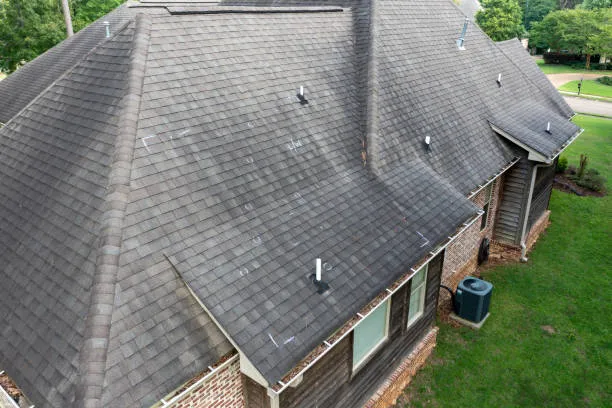
Wind damage roof repair in Colorado Springs.
Hail gets all the attention here, and wind quietly does a different kind of damage on the same roofs. It does not bruise a shingle — it breaks the bond holding it down, and the roof keeps looking fine from the driveway for months afterwards. This page is about how wind actually fails a roof, what to look for, and how a wind claim gets argued.
Wind does not hit a roof. It lifts it.
People picture wind damage as something pushing against the house. It is closer to the opposite. Air moving over a roof accelerates as it crosses the edge and the ridge, and fast air is low-pressure air. The still air sitting in your attic is at higher pressure. The difference pulls upward on the roof surface, and it pulls hardest exactly where the geometry is sharpest: the eave, the rake edge, the ridge, and the corners. That is why wind damage almost never starts in the middle of a slope.
What gives way is the seal strip. Asphalt shingles are held down twice — nails through the shingle, and a strip of adhesive bonding each course to the one below once the sun warms it. Uplift breaks that bond first. The shingle stays nailed, hinges up, and folds back on itself; when the wind drops, gravity lays it flat again and it looks untouched from the ground. It is not. The seal is gone, the shingle is creased along the fold line, and the next event takes it off.
Colorado Springs makes this worse in two ways. The average wind speed here is a mild 9.5 mph, which lulls people into treating wind as a non-issue right up until a convective outburst arrives. The National Weather Service confirmed 70 mph gusts across southern El Paso County on June 22, 2026, through Fountain, Security-Widefield and south Colorado Springs. And at 6,035 feet the summer UV index runs very high, in the 9 to 11 range, which bakes the flexibility out of asphalt. A shingle that has been up here for a decade does not hinge. It cracks.

Six things wind takes, in the order we find them.
A wind inspection is a different walk from a hail inspection. On hail we are reading the field of the slope for impact marks. On wind we are working the edges and the seams, because that is where uplift concentrates.
Creased shingles
The signature of wind. A hard line across the shingle where it folded back and dropped flat again. From the ground it is invisible. From the roof it is obvious, and it means that shingle has a fracture running through its mat whether or not it is leaking yet.
Broken seal strips
The damage nobody photographs, because there is nothing to see. We lift shingles by hand across the affected elevations and check whether they are still bonded. Unsealed courses are a live liability — they will leave in the next event and they let wind-driven rain track sideways in the meantime.
Ridge cap loss
Ridge caps sit at the highest-uplift line on the roof and are held by the least material. They go first and they go in runs. A stripped ridge exposes the ventilation cut in the decking directly to weather, which is why a missing ridge cap turns into an attic problem faster than missing field shingles do.
Rake and eave edge damage
The starter course and the drip edge along the rakes take the initial peel. Once the starter course is compromised the courses above it have nothing anchoring their leading edge, and the failure unzips up the slope from there rather than staying put.
Torn underlayment and exposed deck
Where shingles are gone entirely we check what is under them. Underlayment that has been flapping is usually torn at the fasteners even where it looks intact, and any deck that has been open through a wet spell needs to be checked for saturation before anything goes back over it.
Lifted flashing and vent caps
Step flashing at walls, counter-flashing at chimneys, and the caps on turbine and box vents all get worked loose by sustained uplift. These are small components and they are responsible for a large share of the leaks that show up weeks after a wind event, long after the roof has been declared fine.
What you can actually see without a ladder.
We are not going to tell you to climb up and look. Get a pair of binoculars, stand back at the property line, and work one elevation at a time. These are the signals that are visible from down there.
Shingle debris in the yard
The most reliable indicator there is, and the one most people bag up and forget. Whole shingles, corners, or fragments in the landscaping mean the roof lost material on a specific date. Keep them and photograph them where they landed.
A ragged or interrupted ridge line
Sight down the ridge against the sky. It should read as one straight, uniform line. Gaps, tilted caps, or a section with a different shade are ridge cap loss.
Dark patches on one slope
A rectangle of color that does not match its neighbors is usually exposed underlayment or bare deck where shingles are gone. If it is on the elevation the storm came from, that is consistent.
Interior staining after the next rain
Wind damage frequently announces itself weeks later as a ceiling stain or a damp patch at the top of an exterior wall. By then the date of loss is hard to establish, which is why an inspection right after the storm is worth the hour.
On doing it yourself: Replacing a few shingles looks like a simple job and is not one worth falling off a roof for. The two things that go wrong are nailing pattern and sealing. A hand-placed shingle in cool weather will not bond on its own and needs hand-sealing, and a nail in the wrong line can void what warranty coverage the roof has left. There is also a claim consequence: repair the damage yourself and you have removed the evidence an adjuster needed to see.
A wind claim is argued differently from a hail claim.
On hail, the fight is usually about whether the marks on the roof are impact damage or something else. On wind, the marks are not really in dispute — a creased shingle is a creased shingle. The fight is about two other things: date of loss, and how far the damage extends.
Date of loss matters because wind damage is cumulative and quiet. A roof can carry three seasons of unsealed shingles before anything leaks, and an adjuster has a reasonable argument that the condition is wear rather than a covered event. Tying the damage to a specific storm is the whole ballgame, and it is far easier while the debris is still in the yard. The legal reporting window is a year from the date of loss. The evidentiary window closes long before that.
Extent matters because broken seals do not photograph. An adjuster can count missing shingles on one slope and write for exactly those, which misses every course around them that was lifted, reseated and is now unbonded. We lift and test by hand across the affected elevations so the scope reflects the roof rather than the parts visible from a ladder.
There is also the matching question. Colorado policies typically promise replacement with materials of like kind and quality, and Colorado courts have read that contract language to support matching where the wording is ambiguous. It is a contract obligation rather than a statutory one, but it is a real one, and it matters on a wind repair because a discontinued shingle or a color that has weathered for twelve years cannot honestly be matched to new stock. When that is the situation, we say so in the scope.
We write our scopes in Xactimate, which is what your adjuster is working in too, so the conversation is about line items both sides can read rather than two documents in different formats. The full process, from first notice of loss through supplements, is laid out on our roof insurance claims page.
What actually reduces wind loss next time.
Wind resistance on an asphalt roof is decided at installation and then slowly spent over the roof's life. The things that move the needle are unglamorous: the correct number of nails per shingle placed in the nailing line rather than above it, a proper starter course along the eaves and the rakes, sealed drip edge, and ridge caps rated for the assembly. None of that shows in a photograph of a finished roof, which is precisely why it is where cheap installations save money.
The other half is aging. A shingle seals because the sun warms the adhesive; the same sun, at this elevation and this UV index, eventually hardens the asphalt until it will not re-seal at all. At that point the roof sheds material in ordinary weather and no amount of spot repair reverses it. If we find that condition we will tell you the roof is at the end of its wind life rather than sell you a repair that buys one season.
Call the same week if the roof is missing shingles, if there is debris in the yard, if you can see daylight in the attic, or if a ceiling stain appears. Call within the month if a significant wind event moved through and nobody has looked — that inspection costs you nothing and establishes a dated record whether or not there is anything to claim. L&N has been working roofs in this county for 15 years, and we would rather tell you the roof is fine than find the damage a year later when the paper trail has gone cold.
Get the Wind Damage Documented
Tell us what you saw and when. We'll inspect every elevation, hand-test the seals, and give you a dated record of what is actually up there.
Wind Damage Questions
Wind is a named peril on standard homeowners policies, so wind damage is generally covered — the deductible is the catch. In Colorado, wind and hail deductibles commonly run one to two percent of dwelling coverage, and after 2018 a number of carriers moved to separate wind and hail deductibles of two to five percent. On a small repair that can exceed the cost of the work, so filing gains you nothing. We will say so rather than open a claim you do not want on your record.
Photograph it from the ground, from as many angles as you can get, and photograph any shingles that landed in the yard before you throw them away — those are evidence of the date of loss. Then get the exposed area covered. Bare underlayment will hold water out for a while but it is not a roofing surface, and it fails fast under Front Range UV. Call us and we will get a tarp on it and inspect the rest of the roof, because shingles rarely leave from only one spot.
The phrase gets used for two different things. In some states it is a code provision: repair more than a quarter of the roof and the whole roof has to be brought up to current code. Colorado has no statewide version of that, and whether anything like it applies at your address depends on what your local building department has adopted. Roofers also use it as a rule of thumb, meaning once about a quarter of a roof needs work, replacement usually beats repair over the life of the roof. On a wind repair we check the local code question before scoping, because it changes both the price and what the insurer owes.
Stop the water first, document second, file third. Temporary tarping protects the interior, and most policies expect you to prevent further damage, so keep the receipt. Documentation means dated photos and a written scope, not a verbal description. Only then does it make sense to call the insurer, because an adjuster arriving at an undocumented roof is working from whatever they can see from a ladder on one elevation.
Colorado homeowners have one year from the date of loss to report a claim to their insurer, so June 2026 wind losses have until June 2027. That sounds generous until you realize wind damage often goes unnoticed for months. The roof looks fine from the street and the leak does not show up until the next wet spell. If you think a specific storm did it, get it looked at while the window is open.
Both happen. Isolated loss on one slope of a reasonably young roof is a repair. Widespread seal-strip failure across multiple elevations is a replacement argument, because shingles that have been lifted and dropped back down no longer bond and will leave again in the next event. The honest test is whether the damage is confined and whether we can match the existing shingle. We will show you what we found and explain which of the two you are actually looking at.
Shingles in the yard after the wind?
We'll get the roof covered, inspect the whole thing, and tell you honestly whether this is a repair, a claim, or nothing at all.
Related Reading
Roof Inspection Near Me in Peyton, CO: What It Covers and When to Book
A free roof inspection in Peyton, CO takes 45–60 minutes and checks shingles, flashing, and vents for hail and wind damage. Learn when to book one and what it covers.
Roof Inspection Near Me in Falcon, CO: What to Expect and When to Book One
A free roof inspection in Falcon, CO takes 45–60 minutes and checks shingles, flashing, and vents for hail and wind damage. Learn when to book one and what it covers.
What to Know About Damage Repair Roofing in Colorado Springs
Learn what Colorado Springs homeowners need to know about damage repair roofing — hail, snow, freeze-thaw, insurance claims, and how to vet a local contractor.
What Is an Ice Dam? Causes, Damage, and Prevention
An ice dam is a ridge of ice that traps melting snow on your roof. Learn how ice dams form, why they cause leaks, and how to prevent them in Colorado Springs.