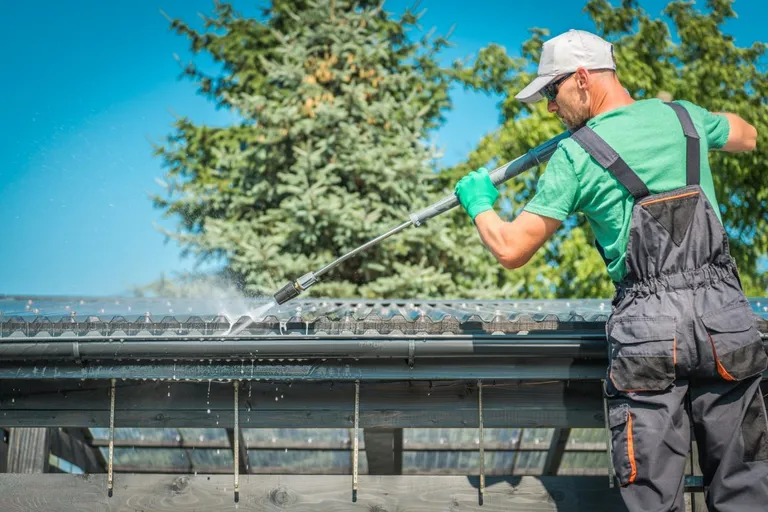
Gutter guard installation in Colorado Springs.
Gutter guards are one of the most oversold products in this trade. The good ones cut your gutter maintenance down to an annual look. The bad ones cost real money and make the problem worse. This page explains which is which, what the pine needles and the freeze-thaw cycle up here do to them, and how to work out whether your house even needs them.
What a gutter guard does, and what it does not.
A guard keeps leaves, needles and twigs out of the trough while letting water in. That is the entire job. Done well, it takes a house from two or three cleanings a year down to one annual inspection, and it removes the specific failure that does the real damage — a gutter so packed with wet debris that it overflows against the fascia, or so heavy that it pulls its own hangers out of the board.
Here is what it does not do. It does not make a gutter self-cleaning. Shingle granules, roof grit and fine windblown dust pass through every guard on the market and settle in the bottom of the trough, and eventually that sediment needs flushing. It does not fix a gutter that was hung with the wrong pitch. It does not prevent ice dams. And it does not compensate for undersized downspouts — if the water cannot get away from the house fast enough, a guard just changes where it backs up.
We say this plainly because the guard business runs on the opposite claim. If someone quotes you a system on the promise that you will never clean your gutters again, you have learned something useful about the company, whatever the product turns out to be.

The five categories, ranked honestly.
Brand names change constantly. The underlying categories do not, and once you know which category a product belongs to you can predict how it will behave on your house.
Micro-mesh
Our default recommendationStainless mesh over a rigid frame, fine enough to stop pine needles and most grit. It is the only category we would put on a house under heavy pine cover, and the only one that reliably handles the fine debris this region produces. Costs the most, and worth it on the right house.
Perforated aluminum
Solid middle groundA punched aluminum sheet over the trough. Handles leaves and larger debris well and holds its shape better than a loose screen. Pine needles can still find the holes. On a house with deciduous trees rather than conifers, this is often all you need.
Reverse curve
Works, with caveatsA solid cover with a curved lip that uses surface tension to pull water around into the gutter while debris carries past. Effective when installed precisely, and unforgiving when it is not. In a hard downpour a poorly set curve sheds water straight over the front.
Screen
Cheap for a reasonA simple mesh or plastic screen dropped into the gutter lip. Stops big leaves, and that is about the extent of it. Needles pass through, then wedge from below where you cannot reach them without lifting the screen out. Fine as a temporary measure, not as a solution.
Foam and brush inserts
We do not install theseFoam wedges and bristle inserts that sit in the trough. They trap the debris they are supposed to exclude, they hold moisture against the metal, and in a freeze-thaw climate that is a bad combination. They are the cheapest option on the shelf and they are the one we tell people to skip.
Why guards that work elsewhere fail here.
Most gutter guard marketing is written for a climate with broad leaves, mild winters and moderate sun. We have none of those. Four local conditions decide whether a guard survives its first few years on a Colorado Springs house.
Pine needles
The dominant debris across Black Forest, Monument and the foothill neighborhoods, and the single hardest thing for a guard to handle. Needles are thin, they arrive constantly rather than seasonally, and they wedge into openings from underneath. This is the fact that pushes most local houses toward micro-mesh.
Freeze-thaw and ice
Winters here bring heavy snow loading and ice damming, particularly on north-facing slopes and poorly ventilated attics. A guard adds a horizontal surface that ice can bridge. It will not cause an ice dam, but a flimsy guard will deform under one, and a foam insert will hold the meltwater right against the metal.
Snow load at the eave
Colorado Springs sees roughly 38 to 45 snow days a year. Snow sliding off a pitched roof lands on the guard first. A rigid framed system takes that; a screen laid loosely into the gutter lip gets pushed out of position and then funnels water behind the gutter for the rest of the winter.
Hail and UV
El Paso County averages seven to ten severe hail days a year, and at 6,035 feet the summer UV index runs very high, in the 9 to 11 range. Hail dents thin aluminum and cracks plastic; UV makes plastic brittle first. Metal guards are the durable answer on both counts.
What we do before the guards go on.
Guards go on last, not first. Before anything gets fitted we clear and flush the existing gutters, because sealing debris under a guard is a problem you cannot see and will not reach. Then we check the pitch of each run toward its downspout and the condition of the hangers and the fascia behind them. A sagging run has to be re-hung before a guard is worth fitting — otherwise you are covering a gutter that already does not drain.
We also look at the roof edge itself. A guard has to sit below the shingle line so that water coming off the roof lands on it, not behind it. Some products are designed to slide under the first course of shingles, and on a roof that is nearing the end of its life we will usually say wait — do the guards when the roof goes on, not months before.
Then the runs get measured, the product gets fitted to the gutter profile you actually have, and the downspout outlets get checked to confirm water leaves the way it should. If you want the wider picture on sizing, materials and seamless runs, our gutter services page covers the whole system.
When we tell people not to bother.
If your house has no trees within reach of the roof, guards are close to a waste of money. Dust and shingle grit will still accumulate, and a guard does not stop those, so you have paid to prevent a problem you did not have. An annual flush is cheaper and does the same job.
If your gutters are old, sagging or already leaking at the seams, guards are the wrong first purchase. Fix or replace the gutter, then guard it. And if the roof is due for replacement inside the next couple of years, wait and do both together — it costs less and avoids fitting a product to an edge that is about to change.
We will tell you which of these applies at the estimate, and we are comfortable talking ourselves out of the work. It is a small job on a house where we would rather be trusted with the big one.
Get Your Gutters Measured
Tell us what is over the roof and what the gutters are doing now. We'll come out, measure the runs, and give you a straight answer on whether guards are worth it here.
Gutter Guard Questions
We price gutter guards by the linear foot of gutter, and the number moves with the product you choose, the height and access of the runs, and whether the existing gutters need re-hanging or cleaning first. We will not put a figure on this page, because the spread between a basic screen and a heavy micro-mesh is wide enough that any single number would be misleading. We measure the runs and quote them itemized.
Three real ones. They reduce cleaning, they do not end it — fine grit and shingle granules still get through most systems and settle in the trough. They add a surface that ice can bridge across in a Colorado winter. And a badly fitted guard is worse than none at all, because water sheets over the top in heavy rain and lands where the gutter was supposed to stop it. We would rather you knew all three before deciding.
Only some of them. Pine needles are the hardest debris for a guard to handle because they are thin enough to slip through a standard screen and then wedge in from underneath, where you cannot reach them. If your house is under ponderosa pines — common through Black Forest, Monument and the foothill neighborhoods — micro-mesh is effectively the only category worth considering, and even then the mesh needs to be fine and rigid.
No, and any company that tells you otherwise is selling. Ice dams form because heat escaping through the roof melts snow that then refreezes at the cold eave. That is a ventilation and insulation problem, and it happens whether or not there is a guard on the gutter. What a guard can do is keep the trough clear so meltwater has somewhere to go once the dam releases. What it cannot do is fix the cause.
Yes, and this matters here. El Paso County averages seven to ten severe hail days a year, with June consistently the worst month. Thin aluminum screens dent and deform, and plastic guards can crack outright. If your house takes a hail hit, the guards should be inspected as part of the same claim scope as the roof and gutters, not treated as a separate problem to deal with later.
Yes, just far less often. We tell people to plan on a look once a year rather than two or three cleanings. Check the downspout outlets, the valleys where debris concentrates, and any run under heavy tree cover. Guards change gutter maintenance from a chore into an inspection, which is a genuinely worthwhile trade — it is just not the "never clean your gutters again" claim you see advertised.
Tired of clearing the gutters?
We'll look at what is dropping on your roof, check the gutters you already have, and quote the guard that actually suits the house.
Related Reading
What Is Drip Edge? Where It Goes and Why Code Requires It
Drip edge is the metal flashing at a roof's eaves and rakes that directs water into the gutter instead of behind the fascia. Profiles, install order, and pricing.
Roof Maintenance Near Me in Falcon, CO: A Seasonal Checklist
Roof maintenance in Falcon, CO means seasonal checks for hail bruising, cracked flashing, and clogged gutters. Here's what to do yourself and when to call a pro.
Roof Maintenance Tips: A Homeowner's Seasonal Checklist
Practical roof maintenance tips for every season — gutter clearing, granule checks, flashing, ventilation, tree clearance, and snow management in Colorado.
Commercial Roof Fires: Causes, Fire Ratings, and How to Protect Your Building
Commercial roof fires most often start from hot work, HVAC electrical faults, and open-flame installation. Learn the causes, UL fire ratings, and prevention steps.