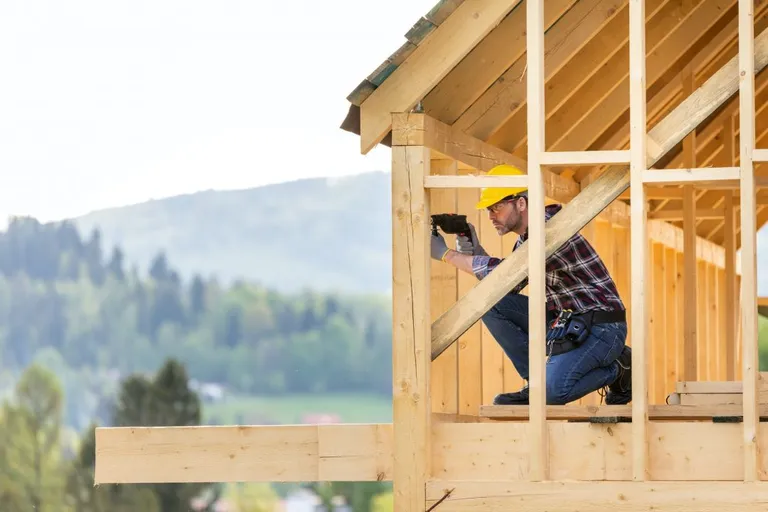
Roof decking repair and replacement in Colorado Springs.
Roof decking, also called sheathing, is the layer everything else is nailed to, and the only layer you get to look at for a few hours every couple of decades. It is also the single most common reason a roof job costs more than the estimate said. This page explains why that happens, and how to tell an honest handling of it from an opportunistic one.
Roof decking is not a deck.
Worth clearing up, because it sends people to entirely the wrong tradespeople. A deck is the structure off the back of your house. Roof decking is the sheet material — most often plywood or OSB on anything built in the last few decades — fixed across the rafters or trusses to form the surface of the roof. Underlayment goes on it, shingles are nailed through into it, and every fastener holding your roof down is relying on it.
Which is why soft decking is not a cosmetic problem. A nail driven into delaminated OSB has very little to grip. The shingle above it looks identical to a properly fastened one, right up until wind gets under the course and finds out. Installing a new roof over compromised sheathing is the most consequential shortcut available on a residential job, and it is completely invisible once the shingles are on.
Older Colorado Springs homes add a second variable. Plank sheathing and, under old wood shake roofs, skip sheathing — spaced boards rather than continuous sheets — turn up regularly on the older housing stock. Neither is a problem in itself. Both change the scope materially if they are discovered on tear-off morning rather than anticipated.

What actually turns up under the shingles.
In rough order of how often we find it on a Colorado Springs re-roof. Most roofs need some decking; very few need all of it.
Localized rot at penetrations
Around a chimney, a pipe boot, a skylight or a wall flashing. A slow leak at a detail wets one area repeatedly, and the sheathing there goes soft while the rest of the slope is sound. Usually a handful of sheets, and the cheapest outcome on this list.
Delaminated OSB
Repeated wetting and drying separates the strands and the board loses its ability to hold a fastener. It often looks acceptable and feels wrong underfoot — swollen at the edges, spongy in the field. This is the one most commonly missed by a crew working quickly.
Damage at the eaves from ice damming
Water backing up under the shingles at a cold overhang and sitting there. It concentrates in a band along the eave, which is a distinctive pattern and a strong signal that the underlying issue is ventilation or insulation rather than the roof covering.
A second layer of shingles
Not decking, but discovered at the same moment and it changes everything downstream: tear-off labor, disposal volume, and often the condition of the deck below, which has been sealed under two layers with whatever moisture was trapped there.
Skip or plank sheathing
Spaced or narrow boards under an old roof. Converting to asphalt shingles means overlaying continuous sheathing, which is a real line item. This is why an accurate age and roof history for the house matters at the estimating stage.
Structural sag or spacing problems
Sheets butted tight with no expansion gap, missing H-clips at unsupported edges, or a genuine deflection in the framing. These are less common and are the cases where the answer is not simply more plywood — they need to be identified and addressed rather than covered over.
Unit rate, not allowance.
Decking is the classic sharp-practice opportunity in residential roofing, and it works because the customer is never on the roof at the moment of discovery. The two versions of the abuse are a lump-sum allowance that gets billed in full regardless of what was replaced, and a mid-job announcement that the whole deck is gone, made to a homeowner who has no way to check and a roof that is currently open to the sky.
The protection is procedural rather than a matter of trust. Agree a unit rate before the job — a price per sheet or per board — so the quantity is the only variable and it is a countable one. Ask that replaced areas be documented, because on a claim that documentation is what the supplement rests on. And ask what the crew does when they find something: the answer should be that they stop and show you, not that they carry on and tell you at the end.
Rate agreed before tear-off
The unit price is in the scope from the start. Nothing about the price is decided while the roof is open and your negotiating position is at its weakest.
Documented for the claim
Storm-damaged decking gets written up while the roof is open so the supplement has something to stand on. Evidence gathered after the new roof is on is worth very little.
Counted, and the count is yours
The number of sheets replaced is reported to you. You are billed for the quantity, not for an estimate of the quantity.
Cause identified, not just the symptom
Rot has a reason — a failed flashing, a ventilation problem, ice damming at the eave. Replacing the wood without addressing the cause guarantees a repeat, and we will tell you which one you are looking at.
Supplement filed while it is open
On a claim, storm-related decking damage is documented and submitted as a supplement at the moment of discovery. Filed later from memory it is worth considerably less.
Code items flagged
Requirements applying to the replacement rather than to the original roof — fastening schedules, spacing and clips among them. Better identified in the scope than at inspection.
On claims: Decking is the most common supplement on a roof claim, because no pre-tear-off estimate can price it accurately. How supplements are documented and filed is set out on our claim documentation and Xactimate page.
When the decking is the symptom.
Sheathing does not rot on its own. Something wetted it, and the pattern of the damage usually says what. Rot concentrated in a band along the eaves points at ice damming, which points in turn at heat escaping into the attic and at ventilation. Generalized darkening across a whole slope with no obvious leak points at condensation on the underside of the deck. Damage in a tight radius points at a failed detail: a boot, a flashing, a chimney.
This matters because new sheathing installed under a new roof with the same underlying problem will do the same thing again, on your money the second time. If what we find suggests a ventilation cause we will say so, and the reasoning is on our roof and attic ventilation page, and the rest of what we do on homes is on the residential roofing page.
We have been working on roofs in Colorado Springs for 15 years, which is long enough to have seen the second failure of a deck that was replaced without anyone asking why the first one happened.
Told Your Deck Is Soft?
Tell us what you were shown. We'll look at the roof and give you a second opinion with photographs.
Roof Decking Questions
No, and the search results mix them constantly. A deck is the outdoor structure off the back of your house. Roof decking — also called sheathing — is the structural sheet material fixed across the rafters or trusses that everything else on the roof is fastened to. If you are looking for backyard deck boards, this is the wrong page. If your roofer said the deck was soft, this is the right one.
Yes, and it is routine. Damaged sheathing is cut out and replaced sheet by sheet, or board by board on older homes, while the roof is stripped. It is not a specialist operation — the constraint is access, which means it happens during a replacement or it happens by opening a roof specifically to do it, at considerably greater cost.
Find out how far it goes before deciding anything. Rot at a single penetration is a repair; rot spread across a slope usually means a long-standing leak or a ventilation problem that will do it again to new material. Either way it needs replacing before a new roof goes on — fasteners do not hold in soft sheathing, which means the roof above it is only as good as the wood underneath.
When the decking was damaged by the covered event, generally yes, and it is typically handled as a supplement once the roof is open and the damage is visible. Decking that has rotted slowly from an old leak or from poor ventilation is a maintenance matter rather than a storm loss, and carriers treat the two differently. The distinction usually comes down to documentation taken while the deck is exposed.
Because nobody can see through shingles. Any figure quoted before tear-off is an allowance, not a measurement. The honest way to handle it is a unit rate — an agreed price per sheet or per board — so you are billed for what is actually replaced and can check it against photographs. A lump-sum decking allowance gets consumed whether or not the work happened.
Spaced boards rather than continuous sheets, used under wood shake and shingle roofs on older homes. It is common enough on the older housing stock around Colorado Springs to be worth checking for. Converting to a modern asphalt shingle roof over skip sheathing means adding continuous sheathing across it, which is a substantial line item and a genuine surprise if it is discovered on the day.
Planning a replacement?
Get the decking handled properly in the scope — unit rate, documented, counted, before anyone gets on the roof.
Related Reading
Roof Repair Cost in Falcon, CO: What Actually Drives the Price
Roof repair cost in Falcon, CO depends on access, pitch, and how many squares are affected — not a flat per-job number. Here is what actually drives the price.
Emergency Roof Repair in Colorado Springs, CO — 24-Hour Response
24-hour emergency roof repair in Colorado Springs, CO. Fast leak stops, emergency tarping, and permanent storm repairs from L&N Construction. Call (719) 355-0648.
Roof Replacement Cost in Peyton, CO: 2026 Pricing Breakdown
Roof replacement in Peyton, CO typically runs $18,000–$21,600 for a 20-square home as of April 2026. See what drives the price and what insurance should cover.
Roof Replacement Near Claremont Ranch in Colorado Springs, CO
Roof replacement contractor serving the Claremont Ranch area of Colorado Springs, CO. Family-owned since 2011, free inspections, honest Xactimate-based estimates.