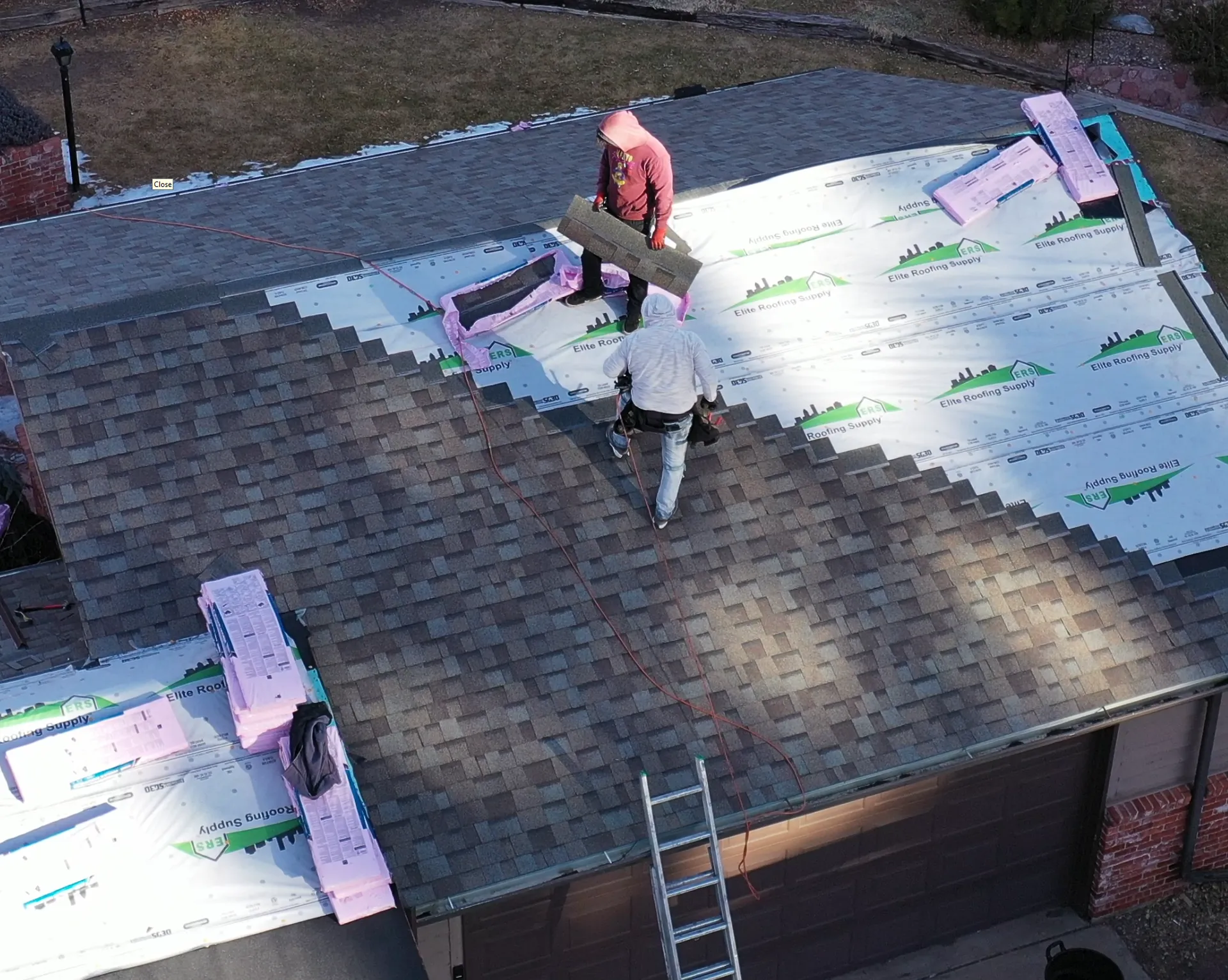
Residential roof replacement in Colorado Springs.
Most roofing pages will not tell you what a roof costs. This one will. Below are real Xactimate figures from Colorado Springs estimates, what each line item on a scope is actually paying for, and which complexity factors move the number — so you can read a bid rather than just receive one.
What a roof replacement actually costs here.
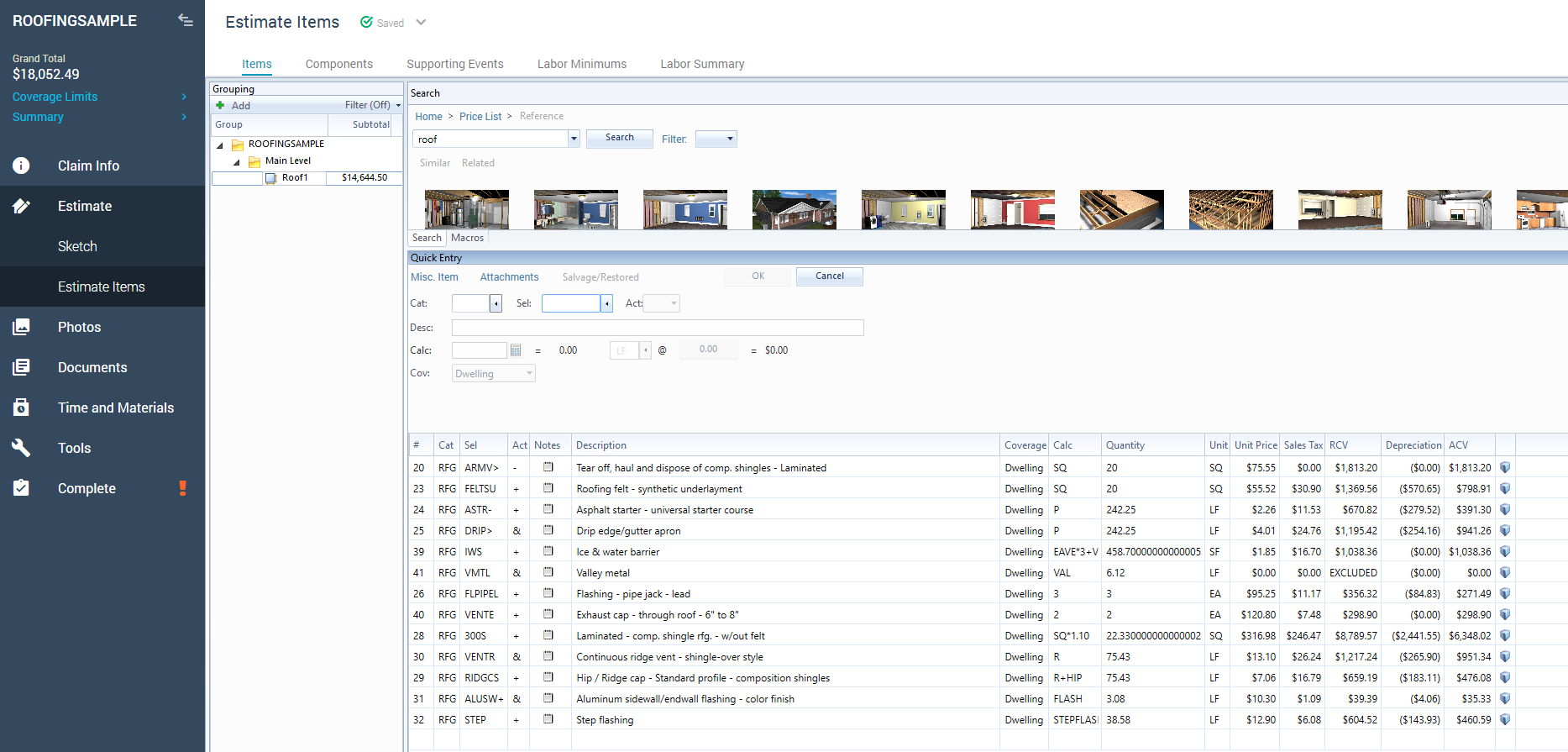
As of April 2026, a 20-square architectural shingle roof on a simple single-story gable in Colorado Springs comes to roughly $18,000 all in on Xactimate pricing — about $9.00 per square foot of roof surface, with the roof subtotal around $14,650 before overhead, profit and sales tax. Take the same 20 squares onto a two-story house with a 7-to-9 pitch and a partial hip and it comes to about $21,600, or roughly $10.80 per square foot. Around a 20 percent premium for complexity, which is a useful rule of thumb.
Two things about those numbers. They are Xactimate figures, meaning insurance-grade pricing, which is the world most roofs in this county actually get replaced in. And they are dated April 2026, because roofing prices move and a number without a date is not information. A retail cash bid on the same roof will usually come in lower, and the reason is worth understanding rather than celebrating.
And a note on square footage, because it trips everyone up. Roofing is priced per square — 100 square feet of roof surface. Twenty squares is about 1,450 square feet of floor footprint on a single-story home at a 6-in-12 pitch, which works out to roughly 2,000 square feet of roof once pitch, overhangs and waste are counted. A house listed at 2,000 square feet is usually a 25 to 30 square roof. Homeowners think in floor plans; contractors think in squares.
What you are paying for, line by line.
A lump-sum bid hides which of these are included. An itemized scope shows them. These are the lines that make up the bulk of a Colorado Springs replacement, with April 2026 Xactimate unit pricing where it is useful.
Tear-off and disposal
about $75 per squareStripping the old roof to the deck, plus haul and dump fees for a single layer. A second layer adds meaningfully to this line, which is one reason the number of existing layers is one of the first things we check.
Underlayment
about $56 per squareSynthetic underlayment across the full deck. It is the secondary water barrier that keeps you dry if wind drives water past a shingle, and it is a line worth confirming is on the estimate rather than assumed.
Ice and water barrier
code required in ColoradoSelf-adhered membrane at eaves and in valleys, required by code in most Colorado jurisdictions. Around 600 to 900 square feet on a typical roof, adding roughly $1,100 to $1,700 in scope that simply would not exist at a lower elevation.
Shingles
about $317 per squareLaminated architectural shingles priced with a 1.15 waste factor, which covers cuts at valleys, hips and rakes. This is the largest single line on the estimate and the one where a cheaper bid is most often quietly buying a different product.
Ridge, hip and ventilation
per linear footContinuous ridge vent at around $13 per foot and hip and ridge cap at around $7. Ventilation is not a finishing touch — inadequate airflow shortens shingle life and drives the ice damming this climate is already prone to.
Flashing and penetrations
per foot and per unitDrip edge and starter course around the perimeter, step and sidewall flashing at around $10 to $13 per foot, and pipe jacks at roughly $95 each. Valley metal is typically excluded here — woven and closed-cut valleys are the Colorado standard.
What moves your roof off the baseline.
These stack. A two-story house with a steep cut-up roof is not one premium, it is three, which is how two houses on the same street with the same square footage end up thousands apart. Figures are percentages of the roof subtotal, April 2026.
Two-story
Adds roughly 4 to 6 percent of the roof subtotal — around $760 to $900 on a 20-square job. It is a labor and staging cost: material handling, safety setup and slower movement at height.
Steep pitch
A 7-to-9 pitch adds roughly 10 to 14 percent, around $1,900 on a 20-square job. Steeper than 10-in-12 pushes toward 18 to 25 percent. Crews work with additional fall protection and move considerably slower.
Cut-up roofs
Multiple gables, hips and dormers add roughly 5 to 10 percent, mostly absorbed in the waste factor and the additional linear feet of flashing. More cuts means more waste and more hand-detailed work.
Chimneys and skylights
Each significant penetration adds roughly $300 to $800. These are hand-flashed details, and they are also where leaks originate, so this is not a place to accept a bid that skims over them.
Class 4 upgrade
Impact-resistant shingles add roughly $100 to $150 per square, about $1.00 to $1.50 per square foot. The insurance premium discount commonly offsets that over three to five years in a county that averages seven to ten severe hail days a year.
Decking replacement
Adds roughly $2.50 to $4.00 per square foot of affected area, and it cannot be priced accurately in advance because nobody knows what is under the shingles. We quote it as a unit rate and bill only what we actually replace.
Why the cheaper bid is often not cheaper.
Insurance pricing and retail cash pricing are two different systems, and most of the confusion homeowners have about roofing costs comes from comparing across them without realizing it. An insurance scope itemizes everything — starter course, drip edge, ice and water, every foot of flashing, ventilation — and applies overhead and profit on qualifying claims. A retail cash bid tends to bundle, leave itemized upgrades out, and skip overhead and profit entirely.
So a cash bid several thousand dollars under an insurance estimate is not necessarily a bargain. Sometimes it is a leaner business. Frequently it is a thinner scope, and the difference shows up as missing ice and water shield, reused flashing, or a shingle a grade below what was discussed. The only way to know is to compare line items, which is why we write ours out rather than handing over a single number.
We estimate in Xactimate whether or not there is a claim involved. On a claim it means we are speaking the insurer's language. On a cash job it means you can see exactly what you are buying and where the optional upgrades are.
A few honest caveats.
Every figure on this page is a Colorado Springs baseline dated April 2026, and your roof is not a baseline. Pitch, access, layer count and what we find on the decking all move it, and nobody — us included — can price your roof honestly without measuring it. Treat these numbers as a way to sanity check a bid, not as a quote.
One more thing worth knowing about roofs at this elevation. Asphalt shingle life in Colorado runs shorter than the warranty on the wrapper suggests. Plan for fifteen to twenty years on architectural shingles rather than the advertised twenty-five to thirty, particularly above 6,000 feet, where the summer UV index runs very high in the 9 to 11 range. Colorado Springs sits at 6,035 feet. That is not a reason to buy a cheaper roof; it is a reason to price the upgrades against a realistic life.
We install Owens Corning shingles, including their impact-resistant lines, and we will walk you through the material options at the estimate. For the wider picture on materials, repairs and the rest of what we do on houses, see our residential roofing page.

Get an Itemized Estimate
Tell us about the house and we'll measure the roof, check the layers and the decking, and write the scope out line by line so you can compare it properly.
Roof Replacement Cost Questions
As of April 2026, typical Xactimate pricing for a 20-square architectural shingle roof in Colorado Springs — a simple single-story gable — comes to roughly $18,000 all in, or about $9.00 per square foot of roof surface. A two-story roof with a moderate 7-to-9 pitch and a partial hip runs closer to $21,600 on the same 20 squares. Those are insurance-grade numbers, which is the world most roofs in this county get replaced in.
Careful with that question, because the numbers mean different things. Roofing is priced per square, and one square is 100 square feet of roof surface. A 2,000 square foot house in a real estate listing usually has 25 to 30 squares of roof — around 3,000 square feet of actual roof surface once pitch, overhangs and waste are accounted for. That is a meaningfully larger job than the 20-square baseline, so scale accordingly rather than assuming your floor area is your roof area.
Two things share the name. As a rule of thumb, once about a quarter of the roof needs work, replacing it usually costs less over the life of the roof than repairing it, which makes it a useful sanity check on a repair quote. In some states it is also a code provision that forces a whole-roof upgrade past that threshold. Colorado has no statewide version, and what applies at your address is up to your local building department. Either way, age, the condition of the underlayment, and whether the damage is one storm or twenty years of wear matter more than the percentage on its own.
Because most Colorado jurisdictions require it by code on eaves and valleys. On a typical 20-square roof that is roughly 600 to 900 square feet of ice and water barrier, which adds around $1,100 to $1,700 to a scope that would not exist in a lower-elevation market. If a bid you are comparing does not show that line, it is either not code-compliant or the cost is buried somewhere less visible.
Usually. Class 4 typically adds around $100 to $150 per square, and many Colorado insurers now require or strongly incentivize them given how often it hails. Some carriers have moved older non-impact roofs to actual-cash-value-only coverage. The premium discount available on a Class 4 roof commonly offsets the upgrade cost over three to five years, which makes it one of the few upgrades in this trade that pays for itself.
Because they are pricing different things. An insurance scope itemizes everything — starter course, drip edge, ice and water, flashing, ventilation — with overhead and profit applied on qualifying claims. Retail cash bids often come in lower because contractors bundle line items, leave out itemized upgrades and do not include overhead and profit. Comparing an insurance estimate to a cash bid without knowing which is which is how people end up feeling misled by both.
Want the number for your roof?
We'll measure it, inspect the decking and layers, and give you an itemized Xactimate scope you can hold up against any other bid.
Related Reading
How Much Does Roof Replacement Cost in Fountain, CO?
A typical Fountain, CO roof replacement runs $18,000–$21,500 for a single-story home as of April 2026. See what drives the price up or down.
Roof Replacement Cost in Peyton, CO: 2026 Pricing Breakdown
Roof replacement in Peyton, CO typically runs $18,000–$21,600 for a 20-square home as of April 2026. See what drives the price and what insurance should cover.
Roof Replacement Near Claremont Ranch in Colorado Springs, CO
Roof replacement contractor serving the Claremont Ranch area of Colorado Springs, CO. Family-owned since 2011, free inspections, honest Xactimate-based estimates.
Roof Replacement Near Mesa Ridge in Fountain, CO
Roof replacement contractor serving the Mesa Ridge area of Fountain, CO. Family-owned since 2011, free inspections, honest Xactimate-based estimates.