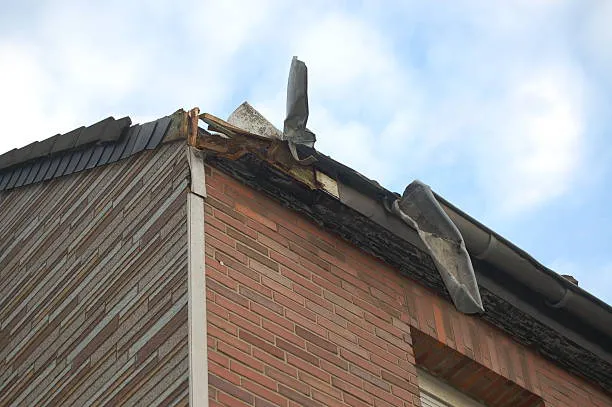
Downspout repair and replacement in Colorado Springs.
The gutter catches the water. The downspout is the part that actually gets rid of it, and it is where most gutter systems fail. Nearly every overflow complaint we are called out to turns out to be a downspout problem wearing a gutter problem's clothes. This page covers how they fail here, when a repair is honest, and when the whole run needs re-sizing.
Your gutter is not overflowing. Your downspout is.
Here is the part almost nobody explains. A gutter trough has far more carrying capacity than the hole cut in the bottom of it. In ordinary rain that does not matter, because water leaves as fast as it arrives. In a hard Front Range downpour it matters enormously — the trough fills faster than the outlet can drain it, the water rises, and it goes over the front edge. The gutter looks like the culprit. The outlet and the pipe below it are the actual constraint.
This is why re-hanging a gutter often does not fix an overflow, and why cleaning it only helps until the next serious storm. If the outlets are small, or there are too few downspouts for the roof area feeding them, the system is capacity-limited by design and no amount of maintenance changes that.
So when we look at an overflowing gutter, the first thing we count is downspouts — how many, where they are, how large the outlets are, and how much roof is draining into each one. Long runs with a single downspout at one end are the usual finding, and adding a second outlet is frequently the whole repair.

Six ways a downspout goes wrong here.
Almost every downspout we replace fits one of these. Knowing which one you have tells you whether you need a repair, a re-size, or a look at something else entirely.
Split at the seam
A downspout is formed metal with a folded seam running its length. Water left standing in the pipe through a freeze expands and works that seam open. You see it as a wet stripe down the wall in spring and nothing at all in summer, which is why it goes unreported for years while it soaks the siding behind it.
Frozen solid
Winters here bring heavy snow loading and ice damming, particularly on north-facing slopes and poorly ventilated attics. Meltwater entering a cold downspout refreezes at the bottom elbow and the pipe packs with ice from the ground up. The next melt has nowhere to go and comes over the gutter instead.
Crushed elbow
The kick-out elbow at the bottom sits exactly at the height of a mower, a wheelbarrow and a car door. Once it is crushed the pipe above it drains at a fraction of its rate and holds water in the winter. It is the single most common downspout repair we make, and the cheapest.
Hail damage
El Paso County averages seven to ten severe hail days a year. Hail dents downspouts and gutter faces along with the roof. Dents alone are cosmetic, but they are legitimate storm damage and belong in the claim scope, which is where they most often get left out.
Pulled off its straps
A downspout full of water or ice is heavy, and the straps holding it to the wall are the weakest link. Once the top separates from the outlet, every gallon off that section of roof runs down the wall. Re-strapping is easy; the question worth asking is what made it that heavy.
Blocked underground
Where a downspout ties into a buried line, the blockage is out of sight and the symptom is water backing up out of the top of the pipe. Root intrusion, collapsed pipe and silt are the usual causes. We check for this before replacing anything above ground, because the visible pipe is rarely the problem.
What we look at before quoting a replacement.
Roof area per downspout
The number that actually matters. A long run of gutter draining into one outlet is undersized no matter how good the pipe is. We measure the contributing roof area and work backward to how many outlets that section needs.
Outlet size and profile
Larger rectangular and round profiles move substantially more water than the small profile that comes standard on a lot of older houses. Where a roof feeds a long run, stepping up the profile is usually cheaper than adding a whole new downspout line.
Gutter pitch toward the outlet
A trough hung dead level holds standing water and delivers it to the downspout slowly. We check the fall on each run with a level before deciding whether the problem is the pipe or the pitch feeding it.
Number of elbows
Every offset and kick-out slows the flow and gives ice somewhere to start. A run that jogs around three architectural features is a run that will freeze first. Sometimes the right answer is to relocate the downspout rather than rebuild the same awkward path.
Material and gauge
Aluminum for almost everything, in a gauge heavy enough not to dent from a ladder. Where a downspout runs somewhere it will get knocked — a driveway edge, a gate, a service path — a heavier gauge at the bottom section is worth the small difference.
Where it discharges
The last two feet decide whether the whole system did its job. Water dropped at the wall goes straight to the foundation. We look at the grade around each outlet and specify extensions, splash blocks or a buried run to daylight accordingly.
When a repair is the right answer.
Most of what goes wrong with a downspout is repairable and should be repaired. A crushed bottom elbow, a loose strap, a separated joint, a blocked outlet — those are small, fast fixes, and a company that quotes a full gutter replacement for any of them is answering a question you did not ask.
Replacement earns its keep in three situations. When the system is genuinely undersized and no repair changes that. When the metal has split along a seam, because a split seam is a manufacturing surface that cannot be reliably sealed back together. And when the downspouts are part of a wider storm claim, where replacing rather than patching gets you a consistent exterior instead of a patchwork of finishes.
We will tell you which of the three you are in, and we are comfortable being the company that quotes the smaller job. Downspouts are usually the first thing we get called about on a house, and how we handle that decides whether we get called about the roof later.
The last two feet matter most.
A downspout that ends at the base of the wall has moved the problem, not solved it. Every storm delivers the water from that section of roof, concentrated into a single stream, into the ground immediately against the foundation. Over enough seasons that is how you get a wet basement, an eroded flower bed and a settling corner.
The fix is usually undramatic. An extension carrying the discharge out past the backfill. A splash block, but only where the ground already falls away from the house — on flat or reverse grade a splash block does nothing. Or a buried line taken out to daylight, which is the tidiest option and the one that needs the most thought, because a buried line that blocks is invisible until it backs up.
We check the grade at each outlet as part of the estimate and say which of those three suits your house. For gutter sizing, seamless runs and the rest of the system this connects to, our gutter services page covers the whole picture.
Get the Downspouts Looked At
Tell us where the water is going wrong. We'll come out, count the outlets against the roof feeding them, and tell you whether this is a repair or a sizing problem.
Downspout Questions
It depends almost entirely on whether the fix is the downspout or the reason the downspout failed. Re-securing a loose leg or replacing a crushed elbow is a small job. Re-sizing every outlet on the house because the originals were never large enough is a different conversation. We will not quote a number before seeing it, but we will tell you which of those two you are looking at before we do any work.
The pipe itself, yes — it is a straight run of formed metal, a couple of elbows and some straps. What is not easy is diagnosing why the old one failed. If a downspout split at the seam, crushed at the elbow, or pulled off its straps, something upstream caused it: ice, an undersized outlet, or a gutter that was never draining toward it properly. Replace the pipe without finding that, and you will replace it again.
Aluminum downspouts routinely last decades, and they usually do not die of old age. They die of damage — hail dents, a ladder set against them, ice splitting a seam, a lawnmower catching the bottom elbow. That is why we look at the whole run before quoting a replacement. If the metal is sound and the failure is local, a repair is honest work and a full replacement is not.
Almost always the outlet, not the pipe. The hole cut into the bottom of the gutter is the actual bottleneck in the system, and if it is undersized or partly blocked, water backs up and spills over the gutter edge right beside a downspout that looks perfectly clear. Enlarging outlets and moving up to a larger downspout profile fixes more overflow complaints than any other single change we make.
Yes. El Paso County averages seven to ten severe hail days a year, with June consistently the worst month, and hail dents downspouts and gutters along with the roof. Because those dents are cosmetic rather than functional, they are the line items most often left off an initial estimate. We photograph and document them with the rest of the exterior so the scope reflects the whole property, not just the roof.
Far enough from the house that the water is genuinely leaving, and onto ground that slopes away. A downspout that ends at the wall is just delivering the entire roof to your foundation in a concentrated stream. Extensions, a splash block on ground that already falls away, or a buried line taken out to daylight all work. Which one suits depends on your grade, and we look at that as part of the estimate.
Water going where it should not?
We'll find out whether it is the pipe, the outlet, or the grade at the bottom — and quote the smallest fix that actually works.
Related Reading
Roof Repair Cost in Falcon, CO: What Actually Drives the Price
Roof repair cost in Falcon, CO depends on access, pitch, and how many squares are affected — not a flat per-job number. Here is what actually drives the price.
Emergency Roof Repair in Colorado Springs, CO — 24-Hour Response
24-hour emergency roof repair in Colorado Springs, CO. Fast leak stops, emergency tarping, and permanent storm repairs from L&N Construction. Call (719) 355-0648.
Roof Replacement Cost in Peyton, CO: 2026 Pricing Breakdown
Roof replacement in Peyton, CO typically runs $18,000–$21,600 for a 20-square home as of April 2026. See what drives the price and what insurance should cover.
Roof Replacement Near Claremont Ranch in Colorado Springs, CO
Roof replacement contractor serving the Claremont Ranch area of Colorado Springs, CO. Family-owned since 2011, free inspections, honest Xactimate-based estimates.