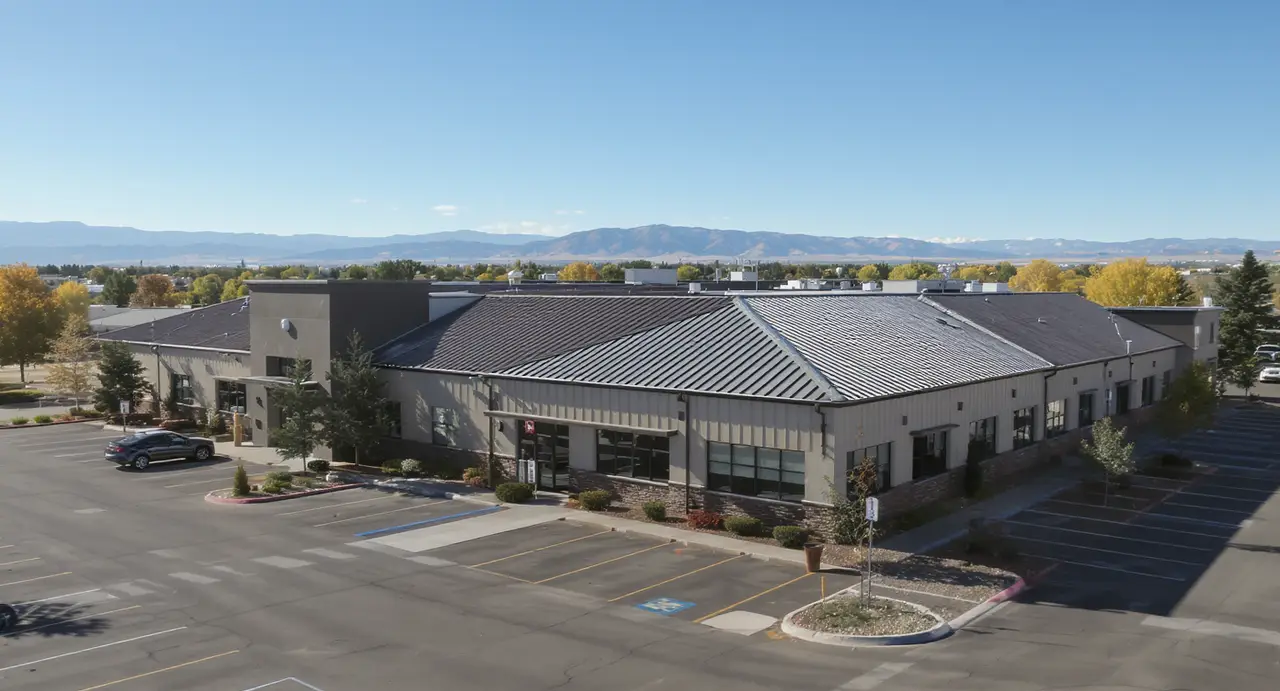
Commercial roof repair in Colorado Springs.
We repair pitched commercial roofs, shingle and metal, on small commercial, multifamily and HOA buildings around Colorado Springs. We find where the water is actually getting in, repair it with materials that match the roof, and tell you straight whether the roof has years left or whether you are patching one that needs replacing.
Where commercial roofs actually leak.
Most leaks on a pitched roof start at a detail, not out in the open field of shingles or panels. The stain on the ceiling is rarely under the hole: water runs along the deck or a rafter before it drips, so the repair starts with tracing it back to the source. These are the places we find it most often on buildings around Colorado Springs.
Vents and penetrations
Pipe boots, exhaust vents and skylights. Every one is a flashed detail, and rubber pipe boots crack in the high-altitude sun long before the shingles around them wear out.
Wall and chimney flashing
Where a roof meets a wall, a parapet or a chimney. At 6,035 feet the roof heats and cools hard every day, and that expand-and-contract cycle works a weak flashing loose over a few seasons.
Valleys
Two roof planes dump their water into one channel. A valley that was cut short, or that lost its ice and water shield, is one of the most common leak points we find.
Wind damage
Lifted and missing shingles, loose ridge caps and backed-out fasteners on metal panels. Once a shingle seal strip lets go, the next wind event usually finishes the job.
Gutters and ice dams
Clogged gutters and poor attic ventilation let ice build up at the eaves in winter, and the meltwater backs up under the shingles.
Hail damage
Hail fractures shingles and knocks their granules loose, and dents metal panels, vents and gutters. El Paso County averages seven to ten severe hail days a year, so this is routine here.

How a commercial repair visit works.
We work on pitched asphalt shingle and metal roofs. The process is the same on every roof we take on.
Find the source
We start inside at the stain, then walk the roof above it and upslope from it: flashings, valleys, vents and anything that has been worked on recently. We photograph what we find and show you, so you are not taking our word for it.
Stop the water if it is coming in
If the building is taking water, we can usually get someone out within 24 hours and put temporary protection in place so the damage stops growing while the permanent repair is scheduled.
Repair with matching materials
Damaged shingles get replaced with a matching shingle. Metal gets matching panels or trim and new fasteners. Flashings get re-flashed, not smeared. Caulk and roof cement buy you a season at best, so we treat them as a stopgap and tell you when that is all a spot has had.
A written, itemized scope
You get the repair written up in Xactimate with line items, the same format an insurance adjuster reads. If the roof has other problems coming, we note them separately so you can plan for them instead of being surprised.
Repair it, or stop patching it?
A sound roof with one bad detail should be repaired, and we would rather do that repair than sell you a roof you do not need. Repairs stop making sense when the problems are spread out: soft decking across large sections, shingles that have lost their granules, leaks at detail after detail, or a roof near the end of its life that needs the same spot fixed every spring. A common rule of thumb is that once more than about a quarter of the roof needs work, replacement usually costs less over the life of the building.
If we get to that point, we will explain why and show you what we found. You can read how we approach a new roof on our roof replacement page, and what metal is like on our metal roofing page.
When the damage came from a storm.
Severe hail moved through El Paso County during the June 2026 storms, and a lot of commercial roofs took it without anyone noticing. Nobody looks at the roof of the building they work in, and cracked shingles and loose granules are hard to see from the parking lot.
Colorado gives you one year from the date of loss to report a claim. We inspect the roof, mark and photograph impacts, and write the scope in Xactimate so the adjuster is looking at the same documentation we are. If the damage is not worth a claim once your deductible is taken out, we will tell you that too. More on how we work with carriers is on our roof insurance claim help page.
A note on scope: Our primary expertise is residential roofing, and our commercial work is on pitched roofs: small offices, retail, mixed-use, multifamily and HOA buildings. We do not repair or install flat or low-slope roofs (TPO, EPDM, PVC, modified bitumen, built-up or coatings). If that is what your building has, you need a commercial membrane contractor. See everything we do on our commercial roofing page.
Get the Leak Found
Tell us about the building and where you are seeing water. We'll schedule an inspection and tell you honestly what is up there.
Commercial Roof Repair Questions
We cannot give you an honest number before we have been on the roof. What drives the price is the roofing material, how many details are involved (wall and chimney flashings, valleys, vent boots), how much decking underneath is damaged, and how steep and hard to reach the roof is. We write the repair scope in Xactimate with itemized line items, so you can see exactly what you are paying for.
No. We do not repair or install flat or low-slope roofs: no TPO, EPDM, PVC, modified bitumen, built-up roofing or roof coatings. Our commercial repair work is on pitched shingle and metal roofs. If your building has a flat roof, you need a commercial membrane contractor.
Often you cannot tell from the ground. On shingles, look for granules collecting in the gutters and at the downspouts; on metal, dents in the panels, vents and gutters. Dented gutters and downspouts are a good sign the roof took a hit too. A documented inspection after the storm is the only reliable way to know.
Sudden damage from hail and wind is commonly covered under a commercial property policy, subject to your deductible and policy terms. Wear, age and deferred maintenance generally are not. Colorado gives you one year from the date of loss to report a claim, so if your building took hail in the June 2026 storms, that window is still open. We document the damage and write the scope in Xactimate, the same software the carriers use.
Twice a year is a good baseline: in spring after the freeze-thaw cycles and in fall before the snow. Add an inspection after any significant hail or wind event. Most of the commercial repairs we do are small problems that sat for a season or two and got bigger.
Yes. If water is coming into the building, call us. We can usually get someone out within 24 hours to find the source and put temporary protection in place while the permanent repair is planned.
Leak on a commercial roof?
We'll find the source, fix what needs fixing, and give you an itemized scope you can compare against anyone else's.
Related Reading
Roof Repair Cost in Falcon, CO: What Actually Drives the Price
Roof repair cost in Falcon, CO depends on access, pitch, and how many squares are affected — not a flat per-job number. Here is what actually drives the price.
Commercial Metal Roofing Contractors Near Me in Falcon, CO
Looking for a commercial metal roofing contractor in Falcon, CO? Here's what standing-seam metal costs, why it holds up in this climate, and what to ask before hiring.
Emergency Roof Repair in Colorado Springs, CO — 24-Hour Response
24-hour emergency roof repair in Colorado Springs, CO. Fast leak stops, emergency tarping, and permanent storm repairs from L&N Construction. Call (719) 355-0648.
Roof Repair Near Aga Park in Fountain, CO
Roof repair contractor serving the Aga Park and Old Town area of Fountain, CO. Family-owned since 2011, free inspections, 24-hour emergency tarping available.